

2026 New Jersey Law Firm SEO Report: Google Search & AI Visibility
Data collection & analysis: TypeTopia Agency Research Team
Reviewed by: Orina Mark, Team Lead TypeTopia, Agency
Study period: July 30–August 8, 2026
AI observation period: July 30–August 3, 2026
Executive Summary
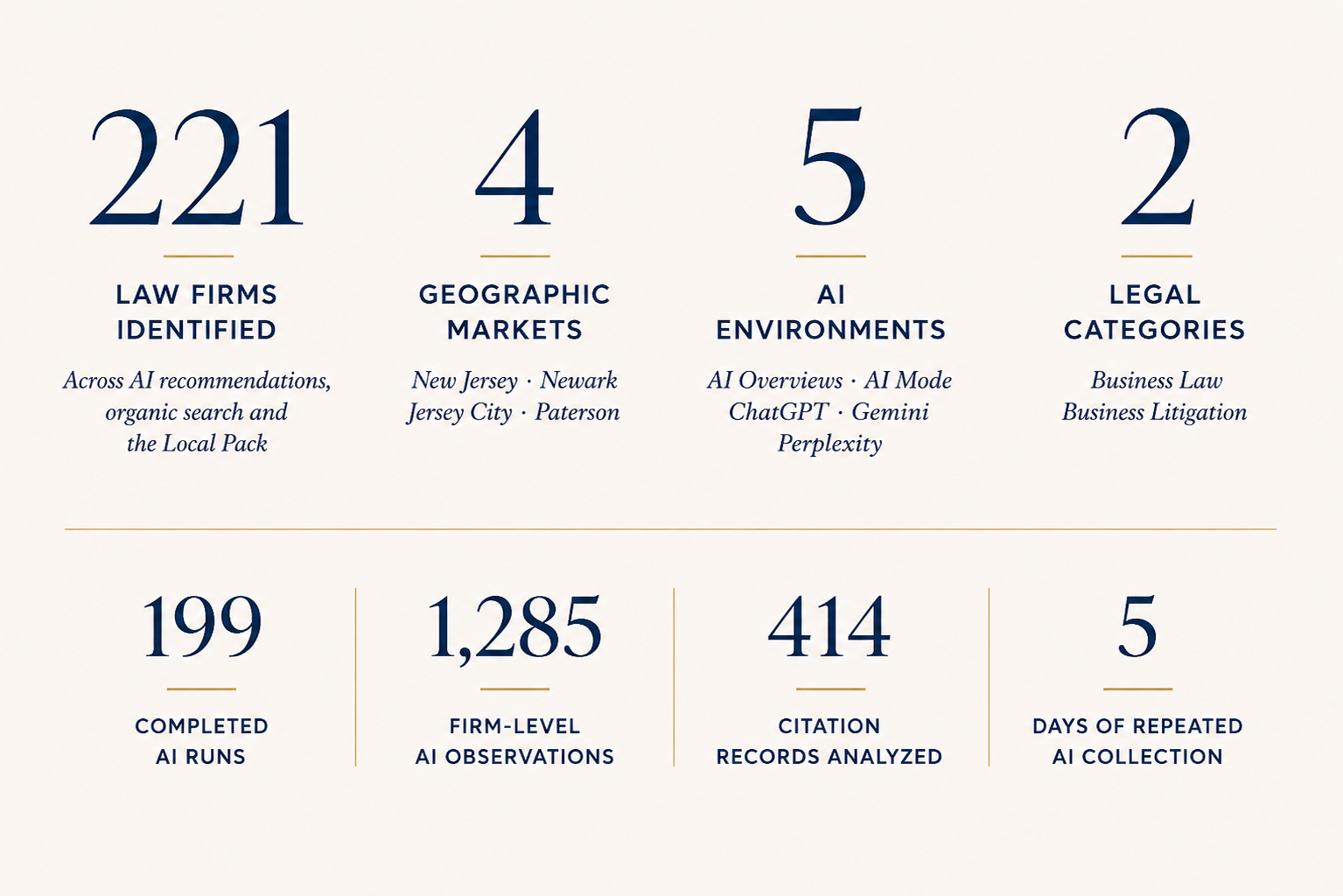
The study covered two legal categories, business law and business litigation, across four geographic markets: New Jersey statewide, Newark, Jersey City and Paterson. We collected Google organic results and the Local Pack results for eight legal-category and market configurations. AI recommendations were collected from Google AI Overviews, Google AI Mode, ChatGPT, Gemini and Perplexity on five consecutive days. The final dataset contained 72 organic positions, 24 Local Pack positions, 199 completed AI runs, 1,285 run–firm observations, and 414 citation records associated with recommended firms.
Principal Findings
Organic Visibility Differed Substantially by Legal Category
Local Pack Visibility Was Highly Specific to the Search Configuration
The Five AI Environments Recommended Substantially Different Groups of Firms
AI Visibility Also Differed by Legal Category and Geographic Market
AI Recommendations Changed Across the Five Collection Days
AI Visibility Rarely Overlapped With Visibility in Google’s Traditional Search Channels
Only three firms appeared across AI recommendations, firm-owned organic results and the Local Pack: Law Offices of John M. Shari, Esq., McOmber McOmber & Luber, and Stark & Stark.
However, none of the three appeared across all three channels for the same legal-category and market configuration.
We examined those three firms more closely in our analysis of law firm SEO ranking factors, including the recurring SEO signals surrounding their visibility.
Citation Support Varied by AI Environment, Legal Category, Market, and Collection Day
Overall Conclusion
For law firms evaluating their digital presence, these findings support measuring each visibility environment independently. Organic rankings, Local Pack appearances, AI recommendation frequency, geographic coverage, consistency, and citation support capture different aspects of discoverability. The citation findings also show that AI-generated recommendations may be accompanied by a firm’s own website, a third-party source or both. Firm-owned practice and service pages represented an important source of visible citation support, but third-party websites also accounted for a substantial share of the recorded citations.
The study was observational and limited to the selected legal categories, markets, prompts, platforms, and collection dates. It measured what the systems displayed under defined conditions. It did not establish why a firm was selected, whether a cited source caused a recommendation or whether a prospective client contacted a listed firm. The findings should therefore be interpreted as a benchmark of observed visibility during the study period, not as a prediction of results for every search, market, or future collection date.
1. Introduction
Over the past three decades, the number and variety of systems potential clients use to discover and evaluate law firms have steadily increased. Personal referrals and professional networks remain among the oldest and most important sources of new business, but prospective clients can now also turn to:
- Online legal directories
- General web search
- Local and map-based search
- Lawyer rating and review platforms
- Social media channels
- Voice assistants
- Generative AI platforms and answer engines
Each new channel has added another layer to the legal-search landscape. These systems have not replaced one another. Instead, they now operate alongside one another, creating more opportunities for law firms to be discovered, but also a more fragmented visibility environment that is difficult to measure.
A firm that ranks prominently in Google’s organic results may be absent in the Local Pack. A firm with strong local visibility may rarely appear in AI-generated recommendations. Even among AI platforms, the firms presented to users can change according to the platform, location, practice area, wording of the question, and individual search run.
This creates an increasingly important problem for law firms: there is no longer one definitive search ranking or single measure of digital visibility. Traditional search performance data alone cannot fully explain which firms prospective clients encounter when they use ChatGPT, Google AI Mode, AI Overviews, Gemini, or Perplexity to ask for legal recommendations.
TypeTopia Agency conducted the 2026 New Jersey Business Law Search and AI Visibility Study to examine law firm visibility across Google’s organic results, the Local Pack and five AI environments. We focused on business law and business litigation searches across four New Jersey geographic markets.
We first recorded which firms appeared in Google’s organic results and the Local Pack. We then tracked corresponding law firm recommendation prompts across Google AI Overviews, Google AI Mode, ChatGPT, Gemini, and Perplexity during five consecutive collection days.
Finally, we compared firm visibility across the measured environments and analyzed the publicly visible sources cited in the AI responses.
2. Research Methodology
2.1 Study Design
TypeTopia Agency conducted a structured observational study that combined cross-sectional Google Search data with repeated AI-response measurements.
We began with two Google keyword themes:
- Business law
- Business litigation
We tested each keyword theme across four New Jersey geographic markets:
- New Jersey
- Newark
- Jersey City
- Paterson
This design produced eight keyword–market configurations. We collected Google’s organic results and Local Pack listings for each configuration as separate datasets and treated them as snapshots of visibility under the specified search conditions.
We then translated the two keyword themes into two natural-language prompts: one for business-law recommendations and one for business-litigation recommendations. We adapted each prompt to the same four markets, producing eight corresponding prompt–market configurations. This approach preserved the underlying legal need and geographic focus across Google and AI while accounting for the different ways people interact with search engines and conversational AI systems.
For the AI portion, we ran each prompt–market configuration once per day across five AI environments for five consecutive collection days. The design produced 200 planned AI runs:
8 configurations × 5 AI environments × 5 days = 200 planned AI runs
We analyzed each dataset independently before comparing firms across organic results, the Local Pack, and AI-generated recommendations. The repeated AI measurements also allowed us to examine how consistently individual firms appeared across environments and collection days.
Because the study was observational, it measured what the platforms displayed under defined conditions. The design supports comparisons of observed visibility, overlap, and consistency, but it cannot establish why a platform selected a firm or whether users contacted that firm.
2.2 Research Questions
The study sought to answer the following questions:
- Which law firms appeared in Google’s organic search results for the selected business-law and business-litigation searches?
- How did organic visibility differ by legal category and geographic market?
- Which law firms appeared in the Local Pack for the selected searches?
- How did Local Pack visibility differ by legal category and geographic market?
- How much overlap existed between the firms appearing in organic search and those appearing in the Local Pack?
- Which law firms did Google AI Overviews, Google AI Mode, ChatGPT, Gemini, and Perplexity recommend?
- How much overlap existed among the firms recommended by the five AI environments?
- How consistently did individual firms appear during the five consecutive days of AI data collection?
- How did AI visibility differ by environment, legal category, and geographic market?
- How often did AI-recommended firms also appear in Google’s organic results or the Local Pack?
- Which publicly visible sources did the AI environments cite in their responses?
- How did citation patterns differ by AI environment, legal category, geographic market, and collection day?
By examining each environment independently before comparing the results, the study provides a multichannel benchmark of observed law firm visibility. This approach distinguishes organic, Local Pack, and AI visibility rather than treating them as interchangeable measures of search performance.
2.3 Legal Search Categories
Category | Scope |
Business law | Contracts, business formation, ownership, governance, transactions, and ongoing business advice |
Business litigation | Contract, ownership, shareholder, and control disputes, as well as related commercial litigation |
2.4 Geographic Markets
The study examined one statewide market and three city-specific markets:
- New Jersey statewide
- Newark
- Jersey City
- Paterson
The statewide configuration captured broad searches for legal services in New Jersey that did not specify a municipality. It also provided a comparison point for examining how results changed when searches included a specific city.
TypeTopia Agency chose Newark, Jersey City, and Paterson because the 2020 Census identified them as New Jersey’s three most populous cities. The Census recorded populations of 311,549 in Newark, 292,449 in Jersey City and 159,732 in Paterson. These markets allowed the study to compare statewide visibility with visibility in the state’s largest urban population centers.
The study used a purposive selection of markets and does not attempt to represent every municipality or region in New Jersey. The city selection emphasized population size rather than statewide geographic distribution.
2.5 Search Matrix
2 legal categories × 4 geographic markets = 8 search configurations
Market | Business law | Business litigation |
New Jersey | ✓ | ✓ |
Newark | ✓ | ✓ |
Jersey City | ✓ | ✓ |
Paterson | ✓ | ✓ |
TypeTopia Agency applied the same eight underlying search intents across the measured Google and AI environments. The wording differed according to how people typically interact with each type of system. Google searches used concise keyword queries, while AI inputs used conversational prompts requesting law-firm recommendations.
Although their wording differed, each Google keyword and its corresponding AI prompt represented the same legal category and geographic market. This alignment allowed the study to compare visibility across environments without treating keyword searches and conversational prompts as identical forms of user interaction.
2.6 Search Inputs
2.6.1 Google Keywords and Search Locations
For example, the Newark business-law configuration used the keyword “business lawyer” with Newark selected as the search location. We did not search for “business lawyer Newark.”
Configuration | Exact keyword | Search location |
G-BL-NJ | business lawyer | New Jersey |
G-BLIT-NJ | business litigation lawyer | New Jersey |
G-BL-NWK | business lawyer | Newark |
G-BLIT-NWK | business litigation lawyer | Newark |
G-BL-JC | business lawyer | Jersey City |
G-BLIT-JC | business litigation lawyer | Jersey City |
G-BL-PAT | business lawyer | Paterson |
G-BLIT-PAT | business litigation lawyer | Paterson |
2.6.2 Keyword Selection and Location-Specific Metrics
On July 30, 2026, we used Semrush to record location-specific keyword metrics for New Jersey, Newark, Jersey City, and Paterson. We applied the same location settings used when collecting the corresponding Google Search results.
Exact keyword | Search location | Estimated monthly search volume | KD (%) | CPC | Intent | Competitive density |
business lawyer | New Jersey | 480 | 15 | $7.90 | Commercial | 0.02 |
business litigation lawyer | New Jersey | 210 | 22 | $8.40 | Commercial | 0.30 |
business lawyer | Newark | 30 | 19 | $13.28 | Commercial | 0.02 |
business litigation lawyer | Newark | 50 | 9 | $0.00 | Commercial | 0.00 |
business lawyer | Jersey City | 40 | 16 | $0.00 | Commercial | 0.02 |
business litigation lawyer | Jersey City | 30 | 24 | $0.00 | Commercial | 0.00 |
business lawyer | Paterson | 30 | 18 | $0.00 | Commercial | 0.00 |
business litigation lawyer | Paterson | 10 | 9 | $0.00 | Commercial | 0.00 |
Semrush defines the reported metrics as follows:
- Search volume: The estimated average number of monthly Google searches for the keyword within the selected location.
- Keyword Difficulty (KD): An estimate of how difficult it would be to rank among the top in Google’s organic results for the keyword, measured on a scale from 0 to 100.
- Cost per click (CPC): The estimated average amount advertisers pay for one click on an advertisement triggered by the keyword.
- Competitive density: A measure of competition among paid-search advertisers, ranging from 0.00 to 1.00. It does not measure competition for organic rankings.
- Search intent: Semrush’s classification of the apparent purpose behind a search. Semrush classified all eight keyword–location configurations as commercial.
TypeTopia Agency recorded these metrics as descriptive context for the selected keywords and geographic markets. The metrics did not determine keyword selection.
Semrush provides further details in its Keyword Overview documentation.
2.7 AI Prompts
The prompts described the legal need in conversational language and asked the AI environment to recommend a law firm. The statewide prompts requested a law firm in New Jersey, while the city-specific prompts requested a local law firm.
Configuration | Exact prompt |
AI-BL-NJ | I own a small business in New Jersey and need legal help with contracts, ownership issues, and major business decisions. Can you recommend a law firm? |
AI-BLIT-NJ | My New Jersey business is facing a serious dispute involving a contract, ownership, or control. Can you recommend a law firm that handles business litigation? |
AI-BL-NWK | I own a small business in Newark, New Jersey, and need legal help with contracts, ownership issues, and major business decisions. Can you recommend a local law firm? |
AI-BLIT-NWK | My business in Newark, New Jersey, is facing a serious dispute involving a contract, ownership, or control. Can you recommend a local law firm that handles business litigation? |
AI-BL-JC | I own a small business in Jersey City, New Jersey, and need legal help with contracts, ownership issues, and major business decisions. Can you recommend a local law firm? |
AI-BLIT-JC | My business in Jersey City, New Jersey, is facing a serious dispute involving a contract, ownership, or control. Can you recommend a local law firm that handles business litigation? |
AI-BL-PAT | I own a small business in Paterson, New Jersey, and need legal help with contracts, ownership issues, and major business decisions. Can you recommend a local law firm? |
AI-BLIT-PAT | My business in Paterson, New Jersey, is facing a serious dispute involving a contract, ownership, or control. Can you recommend a local law firm that handles business litigation? |
The configuration codes identify the input type, legal category, and geographic market:
- AI: Artificial intelligence
- BL: Business law
- BLIT: Business litigation
- NJ: New Jersey statewide
- NWK: Newark
- JC: Jersey City
- PAT: Paterson
TypeTopia Agency finalized the prompt wording before data collection began. We used the same corresponding prompt across the five AI environments and did not intentionally change its wording between environments or collection dates.
2.8 Research Tools
Tool | Role in the study | How TypeTopia Agency used it |
AI-response tracking | Tracked the eight predefined prompts across Google AI Overviews, Google AI Mode, ChatGPT, Gemini, and Perplexity. We used the tracker’s records to identify law firm mentions, positions, and publicly visible sources associated with the responses. | |
Localized Google Search configuration | Generated localized Google Searche and Google Maps links for the eight keyword–market configurations. TypeTopia Agency used the resulting Web SERPs to observe and record organic results and Local Pack listings for each selected market. | |
Keyword research | Provided location-specific search volume, Keyword Difficulty, cost per click, search intent, and competitive-density data for the selected keywords. TypeTopia Agency recorded these metrics on July 30, 2026. | |
Microsoft Excel | Data collection and analysis | Stored, organized, cleaned, and analyzed the collected Google and AI data. TypeTopia Agency used separate worksheets to preserve the results from each measured environment before combining selected fields for cross-environment comparisons. |
2.9 Data Collection Schedule
2.9.1 Google Organic-Results Collection
Collection date | Configurations collected |
July 30, 2026 | G-BL-NJ |
July 31, 2026 | G-BLIT-NJ, G-BL-NWK, G-BLIT-NWK, G-BL-JC, G-BLIT-JC, G-BL-PAT, and G-BLIT-PAT |
2.9.2 Google Local Pack Collection
Collection date | Configurations collected |
August 3, 2026 | G-BL-NJ, G-BLIT-NJ, G-BL-JC, G-BLIT-JC, G-BL-NWK, G-BLIT-NWK, and G-BL-PAT |
August 8, 2026 | G-BLIT-PAT |
2.9.3 AI Collection Schedule
Collection date | Collection day |
July 30, 2026 | Day 1 |
July 31, 2026 | Day 2 |
August 1, 2026 | Day 3 |
August 2, 2026 | Day 4 |
August 3, 2026 | Day 5 |
The study measured five AI environments:
- Google AI Overviews
- Google AI Mode
- ChatGPT
- Gemini
- Perplexity
TypeTopia Agency scheduled one observation for every combination of prompt, AI environment, and collection date:
Surfer returned 199 completed observations from the 200 planned observations. We retained all completed records and treated the missing observation as unavailable rather than replacing or estimating it. The AI analysis therefore used 199 completed observations.
2.10 Channel Specific Data Collection Procedures
2.10.1 Google Organic Results
We collected the Google organic results using the Smoother Media Local SERP Checker. For each keyword–market configuration, we entered the target keyword, selected the corresponding geographic location, and ran a localized Google search. We then exported the data for analysis.
For each law firm appearing in the organic search results, TypeTopia Agency recorded:
- Collection date
- Organic position on the search engine results page (SERP)
- Google title link
- Firm URL
- URL ownership
URL ownership identified whether the ranking URL belonged to the law firm itself or to a third-party website mentioning the firm. This distinction allowed the study to measure law firms’ visibility through firm-owned websites and third-party sources separately.
2.10.2 Google Local Pack Results
We collected the Google Local Pack results using the same Smoother Media Local SERP Checker and localized search process used for the Google organic results. For each keyword–market configuration, we entered the target keyword, selected the corresponding geographic location, ran the search, and exported the results.
We later analyzed these Local Pack results in more detail to identify the patterns shared by the firms ranking in the top three. Read our Google Maps ranking factors for law firms analysis for the full findings.
The study focused on the first three law firms appearing in the Local Pack. For each firm, TypeTopia Agency recorded:
- Collection date
- Firm name
- Local Pack position
- Number of Google reviews
- Business address
2.10.3 AI Visibility Results
We collected the AI visibility data using Surfer’s AI Tracker. We created the eight study prompts in the tracker and scheduled each prompt to run once per day across the five AI environments from July 30 through August 3, 2026.
For each law firm mentioned in an AI observation, TypeTopia Agency recorded:
- Collection date
- Firm name
- Average position within the response
- Visibility score reported by Surfer
- Mention rate reported by Surfer
- Citation URL, when present
When an AI response included multiple citations associated with a firm’s mention, TypeTopia Agency recorded and retained all available citations rather than selecting only one.
3. Results
3.1 Organic Search and Local Pack Visibility Differed by Search Configuration
3.1.1 Organic Visibility Differed by Legal Category and Market
The composition of the results differed substantially between the two legal categories. Business-litigation searches produced 29 firm-owned results across 36 recorded positions, compared with 19 firm-owned results for business-law searches.
Legal category | Organic results | Firm-owned results | Firm-owned share | Third-party results | Third-party share |
Business law | 36 | 19 | 52.8% | 17 | 47.2% |
Business litigation | 36 | 29 | 80.6% | 7 | 19.4% |
Total | 72 | 48 | 66.7% | 24 | 33.3% |
Market | Business-law firms | Business-litigation firms | Firms appearing in both categories |
New Jersey | 4 | 7 | 0 |
Newark | 5 | 6 | 2 |
Jersey City | 5 | 8 | 0 |
Paterson | 5 | 8 | 1 |
Business-law visibility was relatively uniform across the four markets. Four distinct firms appeared through firm-owned results in the statewide search, while five appeared in each of Newark, Jersey City, and Paterson.
Business-litigation visibility varied more. The Newark search produced six distinct firms, the statewide search produced seven, and the Jersey City and Paterson searches each produced eight. The city-specific searches therefore did not necessarily produce narrower firm pools than the statewide search.
3.1.2 Local Pack Visibility Was Highly Search-Specific
Market | Legal category | Position 1 | Position 2 | Position 3 |
New Jersey | Business law | Law Offices of Jason Pollack, Esq. | Alisme Law LLC | Law Offices of John M. Shari, Esq. |
New Jersey | Business litigation | Stark & Stark | Law Offices of David A. Weinstein, P.C. | Epstein Ostrove LLC |
Newark | Business law | Law Offices of Montell Figgins, LLC | Pierre Vanguard Law | Ginarte Gonzalez & Winograd, LLP |
Newark | Business litigation | Law Offices of Montell Figgins, LLC | McOmber McOmber & Luber | Maduabum Law Firm LLC |
Jersey City | Business law | Law Offices of John M. Shari, Esq. | Law Office of Laura M. Fisher LLC | Law Office of Alexander Schachtel |
Jersey City | Business litigation | Law Offices of John M. Shari, Esq. | Law Office of Alexander Schachtel | Romano Law |
Paterson | Business law | Raff & Raff, LLP | Law Offices of Peter N. Davis & Associates, LLC | Salomon & Aquino, LLC |
Paterson | Business litigation | Law Offices of Alex Cirocco, LLC | Raff & Raff, LLP | Kraminsky Law LLC |
Most firms appeared in only one Local Pack. Fifteen of the 19 firms, or 78.9%, were limited to a single configuration. Only four appeared more than once:
- Law Offices of John M. Shari, Esq., appeared three times: third in the statewide business-law results and first in both Jersey City configurations.
- Law Offices of Montell Figgins, LLC, ranked first for both Newark searches.
- Law Office of Alexander Schachtel ranked third for Jersey City business law and second for Jersey City business litigation.
- Raff & Raff, LLP, ranked first for Paterson business law and second for Paterson business litigation.
The business-law configurations contained 11 distinct firms, while the business-litigation configurations contained 12. Only four firms appeared in both legal categories: Law Offices of Montell Figgins, Law Offices of John M. Shari, Esq., Law Office of Alexander Schachtel and Raff & Raff, LLP.
The amount of category overlap differed by market. The two statewide Local Packs shared no firms. Newark shared only Law Offices of Montell Figgins, LLC, although the firm retained the first position in both searches. Jersey City showed the greatest continuity: Law Offices of John M. Shari, Esq., ranked first in both categories, while Law Office of Alexander Schachtel appeared in both but moved from third to second. Paterson shared only Raff & Raff, LLP, which moved from first for business law to second for business litigation.
The ratings attached to the Local Pack listings were uniformly high, ranging from 4.5 to 5.0. Review counts varied much more widely. Among listings with a recorded review count greater than zero, the totals ranged from 30 reviews for Pierre Vanguard Law to 909 for Law Offices of Peter N. Davis & Associates, LLC.
The observed ordering did not consistently follow review count. Law Offices of Peter N. Davis & Associates, LLC ranked second in Paterson with 909 reviews, while Raff & Raff, LLP, ranked first with 274. In Newark, Ginarte Gonzalez & Winograd, LLP, ranked third with 709 reviews, behind Pierre Vanguard Law with 30. These comparisons do not establish which factors determined the rankings, but they show that review volume alone did not explain the recorded Local Pack positions.
Overall, the Local Pack results were highly specific to the combination of legal category and geographic market. Strong Local Pack visibility for one search configuration did not generally carry over to the related category, even when the search location remained unchanged.
3.1.3 Organic and Local Pack Visibility Rarely Overlapped
Firm | Organic appearances | Local Pack appearances |
Law Offices of John M. Shari, Esq. | Newark business law, position 6 | New Jersey business law, position 3; both Jersey City searches, position 1 |
McOmber McOmber & Luber | Business law: New Jersey position 5, Newark position 9, and Paterson position 7 | Newark business litigation, position 2 |
Stark & Stark | Business litigation: Jersey City position 8, and Paterson position 7 | New Jersey business litigation, position 1 |
Exact configuration-level overlap
Comparison | Result |
Firms appearing in both channels somewhere in the study | 3 |
Configurations returning at least one of the same firms in both channels | 0 of 8 |
Local Pack firms also ranking organically for the exact same legal category and market | 0 |
Each of the three overlapping firms crossed channels under different search conditions:
- Law Offices of John M. Shari, Esq., appeared organically for business law in Newark but locally for statewide business law and both Jersey City categories.
- McOmber McOmber & Luber appeared organically for business law but entered the Local Pack for business litigation in Newark.
- Stark & Stark appeared organically for business litigation in Jersey City and Paterson but entered the Local Pack for the statewide business-litigation search.
Therefore, saying that these firms appeared in both organic search and the Local Pack would be accurate but incomplete. None appeared in both channels for the same legal category and market configuration.
3.2 AI Recommendation Pools Differed by Environment, Legal Category, and Market
3.2.1 Recommendation Breadth Differed by AI Environment
ChatGPT produced the broadest recommendation pool, naming 117 distinct firms and averaging 9.7 firms per completed run. Google AI Overviews produced the narrowest pool, naming 35 distinct firms and averaging 3.8 firms per run.
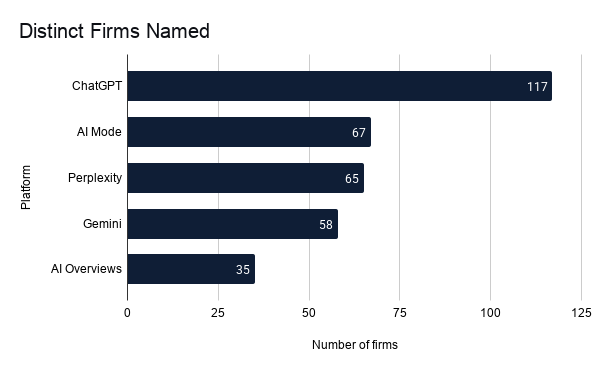
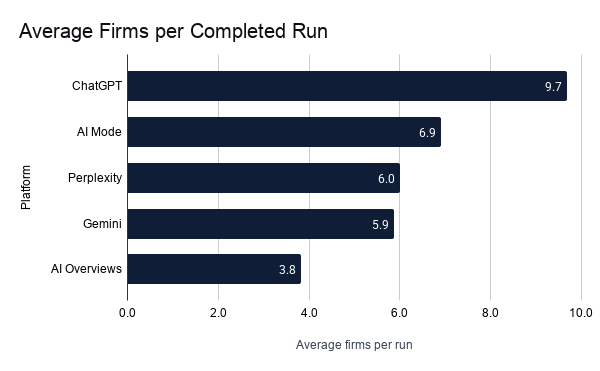
These differences partly reflect how each environment structured its responses. ChatGPT generally produced longer recommendation lists, while Google AI Overviews returned shorter, more concentrated lists. A broader recommendation pool therefore indicates greater variety, but not necessarily greater consistency or stronger source support.
3.2.2 AI Visibility Differed by Legal Category and Market
Business law produced a broader firm pool, while business litigation produced more recommendations per run
Legal category | Completed runs | Firm recommendations | Average firms per run | Distinct firms | Category-exclusive firms |
Business law | 100 | 611 | 6.11 | 140 | 75 |
Business litigation | 99 | 674 | 6.81 | 123 | 58 |
Sixty-five firms appeared in both categories. Seventy-five appeared only in business-law responses, while 58 appeared only in business-litigation responses. Business litigation therefore generated more recommendations per run, but those recommendations were distributed across fewer firms.
McLaughlin & Nardi and Dunn Lambert, LLC led the business-law results, each appearing in 50 of the 100 completed runs. Ehrlich, Petriello, Gudin, Plaza & Reed followed with 28 appearances.
Dunn Lambert, LLC, led business litigation with 42 appearances across 99 completed runs. Sills Cummis & Gross followed with 29, and McCarter & English appeared in 27.
Statewide prompts produced the broadest recommendation pool
Market | Completed runs | Firm recommendations | Average firms per run | Distinct firms | Market-exclusive firms |
New Jersey | 50 | 414 | 8.28 | 97 | 42 |
Newark | 50 | 303 | 6.06 | 64 | 22 |
Jersey City | 49 | 280 | 5.71 | 61 | 31 |
Paterson | 50 | 288 | 5.76 | 76 | 34 |
The statewide New Jersey prompts produced the highest average number of recommendations per run and the largest distinct-firm pool. They averaged 8.28 firms per run and named 97 distinct firms.
Newark averaged 6.06 firms per run and produced 64 distinct firms. Jersey City and Paterson had similar averages, but Paterson produced a broader pool: 76 distinct firms compared with 61 for Jersey City.
The firms appearing most frequently also differed by market:
- New Jersey: Greenbaum, Rowe, Smith & Davis led with 25 appearances, followed by McLaughlin & Nardi with 20, and Riker Danzig LLP with 19.
- Newark: Ehrlich led with 48 appearances, followed by Sills Cummis & Gross with 28, and Gibbons with 18.
- Jersey City: Vyzas & Associates, PC led with 28 appearances, followed by Schumann Hanlon Margulies LLC with 22. Dunn Lambert, McLaughlin & Nardi, and the Law Office of Alexander Schachtel tied with 17 appearances each.
- Paterson: Dunn Lambert led with 47 appearances, followed by McLaughlin & Nardi with 30, and The Law Offices of Abdelhadi & Associates with 13.
Geographic coverage remained limited for most firms. Of the 198 firms named by the AI environments, 129, or 65.2%, appeared in only 1 market. Forty-six appeared in 2 markets, 15 appeared in 3, and only 8 appeared across all 4.
Visibility in one New Jersey market therefore did not reliably translate into visibility in another. The legal category and geographic wording of the prompt affected both the breadth of the recommendation pool and which firms appeared most frequently.
Eight firms appeared at least once across all four geographic markets:
- Connell Foley
- Dunn Lambert, LLC
- Einhorn Barbarito
- Law Offices of Peter J. Lamont
- M. Ross & Associates, LLC
- McLaughlin & Nardi
- Pashman Stein Walder Hayden
- Russo Law LLC
These firms achieved the broadest geographic coverage measured in the study, although their recommendation frequencies varied within and across the four markets.
Four of the eight firms also appeared across all five AI environments:
Firm-name links are provided for identification and do not represent sources cited by the AI environments. Counts combine Google AI Overviews, Google AI Mode, ChatGPT, Gemini and Perplexity. Averages use completed runs, the Jersey City denominator reflects one unavailable Perplexity observation.
3.2.3 Most Firms Appeared in Only One AI Environment
Platform-exclusive firms were not distributed evenly. ChatGPT named 73 firms that appeared in none of the other 4 AI environments, accounting for 54.9% of all platform-exclusive firms. Perplexity produced 26 exclusive firms, Google AI Mode produced 21, Gemini produced 9, and Google AI Overviews produced 4.
AI environment | Exclusive firms | Share of platform’s firm pool |
ChatGPT | 73 | 62.4% |
Perplexity | 26 | 40% |
Google AI Mode | 21 | 31.3 |
Gemini | 9 | 15.5% |
Google AI Overviews | 4 | 11.4% |
Visibility Across Multiple AI Environments Was Uncommon
Visibility across several environments was much less common. Twenty-four firms appeared in 2 environments, 16 appeared in 3, and 12 appeared in 4. Only 13 firms, 6.6% of the 198 AI-recommended firms, appeared across all 5 environments.
AI environments naming the firm | Firms | Share |
One | 133 | 67.2% |
Two | 24 | 12.1% |
Three | 16 | 8.1% |
Four | 12 | 6.1% |
Five | 13 | 6.6% |
3.2.4 Thirteen Firms Appeared Across All Five AI Environments
Rank | Firm | AI runs naming the firm (mention rate) |
1 | 92 (46.2%) | |
2 | 74 (37.2%) | |
3 | 54 (27.1%) | |
4 | 45 (22.6%) | |
5 | 44 (22.1%) | |
6 | 34 (17.1%) | |
7 | 33 (16.6%) | |
8 | 25 (12.6%) | |
9 | 23 (11.6%) | |
10 | 22 (11.1%) | |
11 | 20 (10.1%) | |
12 | 17 (8.5%) | |
13 | 12 (6.0%) |
3.2.5 Platform Breadth Did Not Produce Equal Recommendation Frequency
Dunn Lambert appeared most frequently, in 92 runs, while Stark & Stark appeared in 12. Dunn Lambert was therefore recommended approximately 7.7 times as frequently as Stark & Stark, even though both appeared at least once in all 5 environments.
Recommendation frequency was concentrated near the top of the group. The 3 most frequently recommended firms accounted for 220, or 44.4%, of the group’s 495 observations. The 5 leading firms accounted for 309, or 62.4%.
Platform breadth and recommendation frequency therefore captured different aspects of AI visibility. Platform breadth measured whether a firm appeared in multiple environments; recommendation frequency measured how often it appeared across the complete set of prompts, markets, environments, and collection days.
3.2.6 Platform Breadth Did Not Guarantee Geographic or Category Breadth
Although all 13 firms appeared across the five AI environments, their visibility did not extend equally across the four measured geographic markets.
Geographic markets in which the firms appeared | Firms | Number of firms |
New Jersey, Newark, Jersey City and Paterson | Dunn Lambert; McLaughlin & Nardi; Pashman Stein Walder Hayden; Connell Foley | 4 |
New Jersey, Newark and Paterson | Sills Cummis & Gross; Greenbaum, Rowe, Smith & Davis; Lowenstein Sandler | 3 |
New Jersey and Newark | Ehrlich, Petriello, Gudin, Plaza & Reed; McCarter & English; Gibbons | 3 |
New Jersey and Paterson | Cole Schotz P.C.; Stark & Stark | 2 |
New Jersey and Jersey City | Riker Danzig LLP | 1 |
Market coverage measured whether a firm appeared at least once for a geographic market. It did not measure how frequently or consistently the firm appeared within that market. Consequently, a firm could achieve broad market coverage through relatively few appearances.
Connell Foley illustrates this distinction. It appeared across New Jersey, Newark, Jersey City, and Paterson and across all 5 AI environments, but it was named in only 17 of the 199 completed runs, producing an overall mention rate of 8.5%. By comparison, Ehrlich, Petriello, Gudin, Plaza & Reed appeared in 54 runs but reached only the New Jersey statewide and Newark markets.
Maximum platform coverage therefore did not necessarily translate into visibility across every measured market, and broad geographic coverage did not necessarily indicate a high overall recommendation frequency.
Most Firms Appeared in Both Legal Categories
Twelve of the 13 firms were recommended for both business law and business litigation. Riker Danzig LLP was the only exception: all 20 of its appearances concerned business litigation, specifically the New Jersey statewide and Jersey City configurations. None of the 13 firms appeared exclusively for business law.
Riker Danzig LLP therefore achieved maximum platform coverage without achieving two-category coverage. More broadly, appearing across all five AI environments did not necessarily produce visibility across every legal category or geographic market.
3.3 AI Recommendations Varied Across Collection Days
3.3.1 Most Firm–Segment Combinations Did Not Appear Consistently
AI environment | 1 day | 2 days | 3 days | 4 days | 5 days | Total Combinations |
AI Overviews | 16 (30.2%) | 11 (20.8%) | 6 (11.3%) | 3 (5.7%) | 17 (32.1%) | 53 |
AI Mode | 58 (43.9%) | 33 (25.0%) | 24 (18.2%) | 5 (3.8%) | 12 (9.1%) | 132 |
ChatGPT | 77 (45.0%) | 31 (18.1%) | 24 (14.0%) | 19 (11.1%) | 20 (11.7%) | 171 |
Gemini | 42 (43.3%) | 16 (16.5%) | 13 (13.4%) | 8 (8.2%) | 18 (18.6%) | 97 |
Perplexity | 50 (47.6%) | 16 (15.2%) | 13 (12.4%) | 17 (16.2%) | 17 (16.2%) | 105 |
Total | 243 (43.5%) | 107 (19.2%) | 80 (14.3%) | 52 (9.3%) | 76 (13.6%) | 558 |
AI Overviews produced the most stable recommendation set. It had the lowest one-day rate, at 30.2%, and the highest five-day rate, at 32.1%. Perplexity had the highest one-off rate, at 47.6%.
ChatGPT produced the largest pool, with 171 combinations, but 77 appeared on only one day. Its broad recommendation pool therefore included substantial day-to-day variation.
3.3.2 Frequently Recommended Firms Were Generally More Consistent
Firm group | Firm-segment combinations | Total appearances | Average days per combination | One-off combinations | One-off rate |
50 most frequently recommended firms | 348 | 939 | 2.70 | 109 | 31.3% |
Remaining 148 firms | 210 | 346 | 1.65 | 134 | 63.8% |
Higher overall recommendation frequency was therefore generally associated with greater consistency during the study period. It did not, however, mean that a firm appeared consistently in every AI environment, legal category, or market.
One scheduled Perplexity run for the Jersey City business litigation segment was unavailable. That segment contained four completed collection across the five days. Two firm combinations appeared in all four completed runs and are included in Perplexity’s four-day category. The missing fifth-day observation was not estimated or replaced.
The results show that a firm’s appearance in a single AI response did not establish sustained visibility. Recommendation consistency varied substantially across environments and firms during the five-day collection period.
3.4 AI Visibility Rarely Overlapped with Google Visibility
3.4.1 Most AI-Recommended Firms Did Not Appear in Either Google Channel
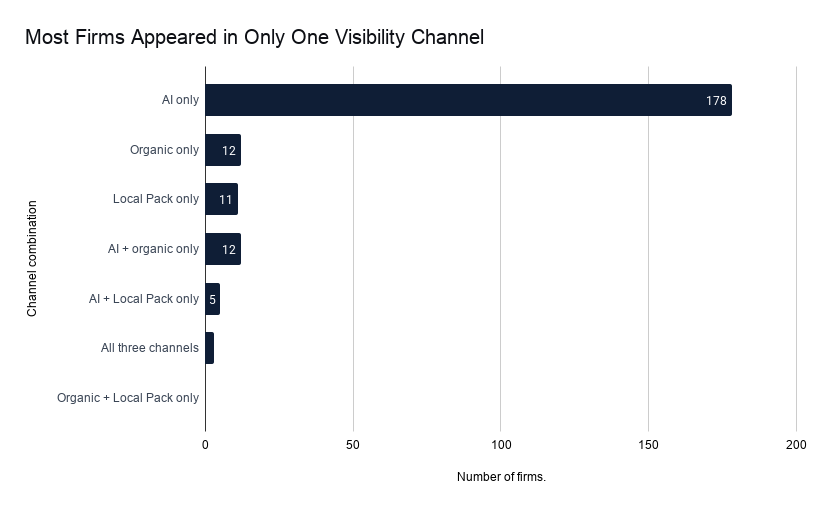
The study identified 221 distinct law firms across AI-generated recommendations, Google organic results, and the Local Pack. AI environments named 198 firms, organic results included 27 distinct firms through firm-owned URLs, and the Local Pack included 19 firms.
These channel totals alone do not show whether the same firms appeared in each environment. The cross-channel analysis found limited overlap:
- 178 firms appeared only in AI recommendations
- 12 firms appeared only in organic results
- 11 firms appeared only in the Local Pack
- 12 firms appeared in both AI and organic results, but not the Local Pack
- Five firms appeared in both AI and the Local Pack, but not organic results
- Three firms appeared across all three channels
- No firm appeared in organic results and the Local Pack without also appearing in AI recommendations
Of the 198 firms recommended by the AI environments, 15, or 7.6%, also appeared through a firm-owned organic result. Eight, or 4.0%, also appeared in the Local Pack. Twenty AI-recommended firms, or 10.1%, appeared in at least one of the two Google channels.
3.4.2 Only Three Firms Appeared Across AI, Organic Search, and the Local Pack
The three firms were Law Offices of John M. Shari, Esq., McOmber McOmber & Luber, and Stark & Stark. Together, they represented 1.4% of all firms identified across the three channels.
Firm | AI visibility | Firm-owned organic visibility | Local Pack visibility |
Law Offices of John M. Shari, Esq. | 8 runs; 4.0% mention rate; one AI environment; average position 6.75 | One business-law configuration: Newark at position 6 | Three appearances: New Jersey business law at position 3; Jersey City business law at position 1; Jersey City business litigation at position 1 |
McOmber McOmber & Luber | 31 runs; 15.6% mention rate; four AI environments; average position 4.11 | Three business-law configurations: New Jersey at position 5, Newark at position 9 and Paterson at position 7 | Newark business litigation at position 2 |
Stark & Stark | 12 runs; 6.0% mention rate; five AI environments; average position 5.08 | Two business-litigation configurations: Jersey City at position 8 and Paterson at position 7 | New Jersey business litigation at position 1 |
McOmber McOmber & Luber had the highest AI recommendation frequency, appearing in 31 runs. It was recommended across four of the five AI environments and three markets: New Jersey, Newark, and Paterson. It also appeared in three firm-owned organic configurations, more than either of the other two firms. However, McOmber was absent from ChatGPT and appeared in the Local Pack only once.
Stark & Stark appeared less frequently in AI recommendations, with 12 appearances, but achieved the broadest platform coverage. It was the only one of the three firms to appear in all five AI environments. Its AI visibility was concentrated in New Jersey and Paterson, while its two firm-owned organic appearances came from Jersey City and Paterson. Stark & Stark also ranked first in the statewide business-litigation Local Pack.
Law Offices of John M. Shari, Esq. appeared in eight AI runs. All eight recommendations came from ChatGPT, making its AI visibility less platform-diverse than that of McOmber McOmber & Luber or Stark & Stark. Its recommendations nevertheless extended across three markets: New Jersey, Newark, and Jersey City. The firm also appeared through a firm-owned organic result for Newark business law and had the broadest Local Pack presence of the three, appearing in three configurations: statewide business law and both the business law and business litigation searches in Jersey City.
The firms also differed in practice area alignment. Twenty-six of McOmber McOmber & Luber’s 31 AI appearances concerned business law, and all three of its firm-owned organic rankings came from business law searches. Its Local Pack appearance, however, came from the Newark business litigation search.
Stark & Stark showed the strongest practice-area consistency. Eleven of its 12 AI appearances concerned business litigation, and both of its firm-owned organic appearances and its Local Pack appearance also came from business litigation searches.
All eight of Law Offices of John M. Shari, Esq.’s AI appearances concerned business law, as did its firm-owned organic appearance. Two of its three Local Pack appearances also came from business law searches, while the third came from the Jersey City business litigation search.
Citation support created another distinction between the firms. McOmber McOmber & Luber received citations in 18 of its 31 AI appearances, producing a cited-mention rate of 58.1%. Its cited sources included the firm’s business law practice page and a Justia directory page. Stark & Stark received citations in five of its 12 appearances, a cited-mention rate of 41.7%, and all five citation records pointed to firm-owned business or business litigation pages. Law Offices of John M. Shari, Esq. received no citations in its eight AI appearances.
For McOmber McOmber & Luber and Stark & Stark, the same firm-owned pages appeared in more than one visibility environment. McOmber McOmber & Luber’s business law practice page ranked in each of its three organic configurations and was also repeatedly cited in AI responses. Stark & Stark’s business litigation practice page ranked organically in Jersey City and Paterson and was cited in four AI appearances. No equivalent page-level overlap was observed for Law Offices of John M. Shari, Esq., whose firm-owned organic result pointed to its homepage but whose AI appearances contained no citations.
This page-level overlap is an observed association. The study does not establish that the pages caused either the organic rankings or the AI recommendations.
Three-channel coverage was measured at the firm level across the complete study, not at the individual configuration level. None of the three firms appeared in AI recommendations, a firm-owned organic result, and the Local Pack for the same combination of practice area and geographic market. Cross-channel presence therefore did not represent one uniform visibility outcome.
Central finding:
Visibility across AI recommendations, firm-owned organic results, and the Local Pack was exceptionally uncommon. Even the three firms present in all three channels achieved that coverage in markedly different ways: McOmber McOmber & Luber through higher AI recommendation frequency and broader organic visibility, Stark & Stark through greater AI-platform breadth and consistent business litigation visibility, and Law Offices of John M. Shari, Esq. through ChatGPT visibility combined with broader Local Pack coverage.
3.5 Citation Practices Differed by Environment, Legal Category, Market, and Collection Day
3.5.1 Citation Support Differed by AI Environment
AI environment | Runs with citations | Completed runs | Citation response rate | Citation records |
AI Overviews | 30 | 40 | 75.0% | 82 |
AI Mode | 31 | 49 | 77.5% | 128 |
ChatGPT | 14 | 40 | 35.0% | 29 |
Gemini | 28 | 40 | 70.% | 74 |
Perplexity | 27 | 39 | 69.2% | 101 |
3.5.2 Business Law Recommendations Received More Citation Support
Business law prompts produced citations in 75 of 100 completed runs, a citation response rate of 75.0%. Business litigation prompts produced citations in 55 of 99 completed runs, a rate of 55.6%.
The difference remained when citation support was measured at the individual firm-recommendation level. Of the 611 business law run–firm observations, 192 were associated with at least one citation, producing a cited-mention rate of 31.4%. Business litigation produced 150 cited observations among 674 run–firm observations, or 22.3%.
Business law therefore had both a higher probability that a completed response would contain a citation, and a higher probability that an individual recommended firm would have visible citation support.
3.5.3 Citation Support Changed Across Collection Days
On Day 1, 37 of 40 completed responses contained at least one citation, producing a citation response rate of 92.5%. The rate declined to 70.0% on Day 2 and 56.4% on Day 3, increased to 62.5% on Day 4, and then fell to 45.0% on Day 5.
Cited-mention rates showed a similar pattern. On Day 1, 157 of 373 firm recommendations were associated with at least one citation, a rate of 42.1%. The rate fell to 22.7% on Day 2 and 16.7% on Day 3, rose to 27.6% on Day 4, and reached its lowest level, 13.4%, on Day 5.
The changes were therefore substantial, but they did not form a continuous day-by-day decline because both measures increased on Day 4. The results instead show that visible citation support varied considerably during the five-day observation period.
One scheduled Perplexity observation for the Jersey City business litigation configuration was unavailable on Day 3. Day 3 therefore contains 39 completed runs rather than 40. The unavailable observation was excluded from the denominator rather than treated as an uncited response.
These results describe changes in the citations visibly presented with the collected responses. They do not establish why citation behavior changed between collection days or whether the same patterns would persist over a longer observation period.
3.5.4 AI Environments Cited Both Firm-Owned and Third-Party Sources
AI environment | Firm Owned Records | Third Party Records | Total citation records | Firm Owned Share |
AI Overviews | 50 | 32 | 82 | 61.0% |
AI Mode | 91 | 37 | 128 | 71.1% |
ChatGPT | 21 | 8 | 29 | 72.4% |
Gemini | 39 | 35 | 74 | 52.7% |
Perplexity | 41 | 60 | 101 | 40.6% |
Total | 242 | 172 | 414 | 58.5% |
Perplexity produced the opposite pattern. Only 40.6% of its citation records pointed to firm-owned websites, while 59.4% came from third-party sources. Gemini was nearly balanced, with 39 firm-owned and 35 third-party records.
The 414 records represented 74 distinct cited URLs. Fifty-three were firm-owned URLs, while 21 came from third-party websites.
Third-party citations were concentrated among four source families:
Third Party Source | Citation Records |
68 | |
33 | |
27 | |
26 | |
7 | |
Other third-party sources | 11 |
Total | 172 |
Firm-owned citations were also concentrated. newark-lawyers.com, the website of Ehrlich, Petriello, Gudin, Plaza & Reed, generated 52 records. McLaughlin & Nardi’s esqnj.com generated 49, while Dunn Lambert’s njbizlawyer.com generated 22. Together, these three domains accounted for 123 of the 242 firm-owned citation records, or 50.8%.
The source mix therefore differed substantially by AI environment. A recommendation could be supported by the recommended firm’s own website, a third-party website, or both. These findings describe the citations visibly associated with firms in the collected responses; they do not establish that a cited page caused an environment to recommend a firm.
Citation records count repeated observations. The same URL could contribute more than one record when it appeared in association with firms across different responses.
Appendix A: Detailed Organic Results
Firm-Owned Page Types and Third-Party Sources
Market | Practice, service or location pages | Firm homepages | Third-party results |
New Jersey | 9 | 2 | 7 |
Newark | 6 | 5 | 7 |
Jersey City | 10 | 3 | 5 |
Paterson | 9 | 4 | 5 |
Perplexity | 34 | 14 | 24 |
Total | 34 | 14 | 24 |
Six firms accounted for 22 of the 48 firm-owned results. Dunn Lambert appeared most frequently, ranking in six configurations. Oberheiden P.C. appeared in all four business litigation configurations, while Cohen Schneider, McOmber McOmber & Luber, Fernandez Garcia Law, and The Linden Law Group each appeared in three.
Firm | Configurations and positions | URL that ranked | Page type |
Dunn Lambert | Business law: New Jersey (9), Newark (5), Jersey City (9), Paterson (3); business litigation: Newark (6), Paterson (3) | Home Page | |
Oberheiden P.C. | Business litigation: New Jersey (1), Newark (3), Jersey City (2), Paterson (2) | Business-litigation page statewide; New York City business-litigation page in the three city markets | Practice-area pages |
Cohen Schneider | Business law: Newark (8), Jersey City (5), Paterson (6) | Homepage | |
McOmber McOmber & Luber | Business law: New Jersey (5), Newark (9), Paterson (7) | Practice-area page | |
Fernandez Garcia Law | Business litigation: New Jersey (5), Newark (5), Paterson (6) | Location-specific practice page | |
The Linden Law Group | Business litigation: Newark (9), Jersey City (5), Paterson (9) | Homepage |
Oberheiden presented a different pattern. Its general business litigation page ranked first in the statewide search, while its New York City business litigation page appeared in the localized Newark, Jersey City, and Paterson results. This provides a concrete example of a city-configured Google search returning a page focused on a neighboring out-of-state market.
Third-party visibility was concentrated among a small number of domains. Super Lawyers appeared seven times and was present in every market. Justia appeared four times, once in every business law configuration. Yelp appeared in the Newark and Jersey City business law results, while Best Lawyers appeared in the statewide and Newark business litigation results.
Third-party source | Organic appearances | Markets appearing |
Super Lawyers | 7 | New Jersey, Newark, Jersey City and Paterson |
Justia | 4 | New Jersey, Newark, Jersey City and Paterson |
Yelp | 2 | Newark and Jersey City |
Best Lawyers | 2 | New Jersey and Newark |
Appendix B: Citation Profiles of Firms Appearing Across All Five AI Environments
Citation Support Varied Among the Thirteen Firms
Citation support varied considerably among the firms:
Firm | Runs naming firm | Third Party Records | Cited-mention rate | AI environments providing citations |
Dunn Lambert, LLC | 92 | 30 | 32.6% | 5 |
McLaughlin & Nardi | 74 | 44 | 59.5% | 5 |
Ehrlich, Petriello, Gudin, Plaza & Reed | 54 | 38 | 70.4% | 5 |
Sills Cummis & Gross | 45 | 35 | 8.9% | 3 |
Greenbaum, Rowe, Smith & Davis | 44 | 15 | 34.1% | 4 |
McCarter & English | 34 | 4 | 11.8% | 3 |
Gibbons | 33 | 3 | 9.1% | 2 |
Pashman Stein Walder Hayden | 25 | 12 | 48.0% | 3 |
Lowenstein Sandler | 23 | 4 | 17.4% | 3 |
Cole Schotz P.C. | 22 | 8 | 36.4% | 3 |
Riker Danzig LLP | 20 | 4 | 20.0% | 3 |
Connell Foley | 17 | 7 | 41.2% | 3 |
Stark & Stark | 12 | 5 | 41.7% | 4 |
Several frequently recommended firms received much less citation support. Sills Cummis & Gross appeared in 45 runs but received an associated citation in only four, producing a cited-mention rate of 8.9%. Gibbons was cited in three of its 33 appearances, or 9.1%, while McCarter & English was cited in four of 34, or 11.8%.
Dunn Lambert also demonstrates the difference between recommendation frequency and citation support. It led the group with 92 appearances, but only 30 of those appearances included an associated citation, producing a cited-mention rate of 32.6%. By comparison, Ehrlich appeared less frequently but received citations in a substantially greater proportion of its appearances.
Citation breadth also differed from recommendation breadth. Although all 13 firms appeared across all five AI environments, only Dunn Lambert, McLaughlin & Nardi, and Ehrlich received at least one associated citation in every environment. Gibbons received citations in only two environments, while the remaining firms received citations in three or four.
A cited run counted once when the firm’s appearance had at least one associated citation, regardless of how many individual URLs were displayed. This prevented responses containing multiple URLs from carrying greater weight in the cited-mention rate.
All 13 firms therefore achieved five-platform recommendation coverage, but only three achieved five-platform citation coverage. Recommendation frequency and visible citation support represented related but distinct dimensions of AI visibility.
Firm-Owned and Third-Party Sources Supported the Firms Differently
Source ownership | Citation records | Share of citation records |
Firm-owned pages | 144 | 61.3% |
Third-party pages | 91 | 38.7% |
Total | 235 | 100.0% |
Firm | Firm -owned Citation Records | Third Party Citation Records | Total Citation Rercords |
Dunn Lambert, LLC | 22 | 13 | 35 |
McLaughlin & Nardi | 49 | 13 | 62 |
Ehrlich, Petriello, Gudin, Plaza & Reed | 52 | 13 | 65 |
Sills Cummis & Gross | 0 | 6 | 6 |
Greenbaum, Rowe, Smith & Davis | 12 | 4 | 16 |
McCarter & English | 0 | 4 | 4 |
Gibbons | 0 | 4 | 4 |
Pashman Stein Walder Hayden | 3 | 11 | 14 |
Lowenstein Sandler | 0 | 8 | 8 |
Cole Schotz P.C. | 0 | 7 | 7 |
Riker Danzig LLP | 1 | 4 | 5 |
Connell Foley | 0 | 7 | 7 |
Stark & Stark | 5 | 0 | 5 |
Total | 144 | 91 | 235 |
The remaining six firms’ observed citations came entirely from third-party sources: Sills Cummis & Gross, McCarter & English, Gibbons, Lowenstein Sandler, Cole Schotz, and Connell Foley.
Firm-owned citation visibility was particularly concentrated among three firms. Ehrlich generated 52 firm-owned citation records, McLaughlin & Nardi generated 49, and Dunn Lambert generated 22. Together, these firms accounted for 123 of the 144 firm-owned citation records, or 85.4%.
This concentration shows that the overall 61.3% firm-owned share did not describe every firm equally. Some firms received substantial citation visibility through their own websites, while others appeared across all five AI environments without having a firm-owned page visibly cited.
Firm-Owned Citations Primarily Pointed to Practice-Area Pages
Firm-owned page type | Citation records | Share of firm-owned citation records |
Practice-area or legal-service page | 121 | 84.0% |
Third-party Firm homepage | 23 | 16.0% |
Total | 144 | 100.0% |
Firm-owned page type | Distinct pages | Share of distinct firm-owned pages |
Practice-area or legal-service page | 19 | 90.5% |
Third-party Firm homepage | 2 | 9.5% |
Total | 21 | 100.0% |
Only Dunn Lambert and Ehrlich had firm homepages among their cited URLs. The 23 homepage citation records came from those two pages, with Dunn Lambert’s homepage accounting for 21 records.
No firm-owned attorney biography appeared among the 21 distinct firm-owned pages. The reviewed firm-owned sources also did not include articles or general informational resources. Within this group, the visible firm-owned citations instead pointed to homepages and pages directly describing relevant legal services.
Third-Party Citations Were Concentrated Among Several Sources
Firm-owned page type | Citation records | Share of third-party citation pages |
Justia | 19 | 90.5% |
Chambers | 2 | 9.5% |
Super Lawyers | 21 | 100.0% |
Expertise.com | 13 | 14.3% |
Law Firm Square | 6 | 6.6% |
Best Lawyers | 3 | 3.3% |
Cornell Legal Directory | 2 | 2.2 |
The cited third-party pages generally consisted of geographic lawyer lists, practice-area directories, rankings, and comparative lists. A single third-party page could be associated with several recommended firms. Chambers’ New Jersey commercial litigation ranking, for example, appeared in connection with multiple firms in the group.
The source patterns demonstrate that firms reached visible citation support through different pathways. Some firms were associated primarily with their own practice-area pages, some appeared through both firm-owned and third-party pages, and others relied entirely on external directories or ranking sources within the observed responses.
These findings describe the citations visibly presented in association with the firms during the collection period. They do not establish that a cited page caused an AI environment to recommend a firm, reveal every source used to generate a response, or demonstrate that creating a similar page would produce the same outcome.
A citation record represented one observed appearance of a URL in connection with a firm. When the same URL appeared across multiple responses, it contributed multiple citation records. Citation-record totals therefore measure citation frequency rather than the number of unique webpages.