How to Rank Your Law Firm on Google Maps
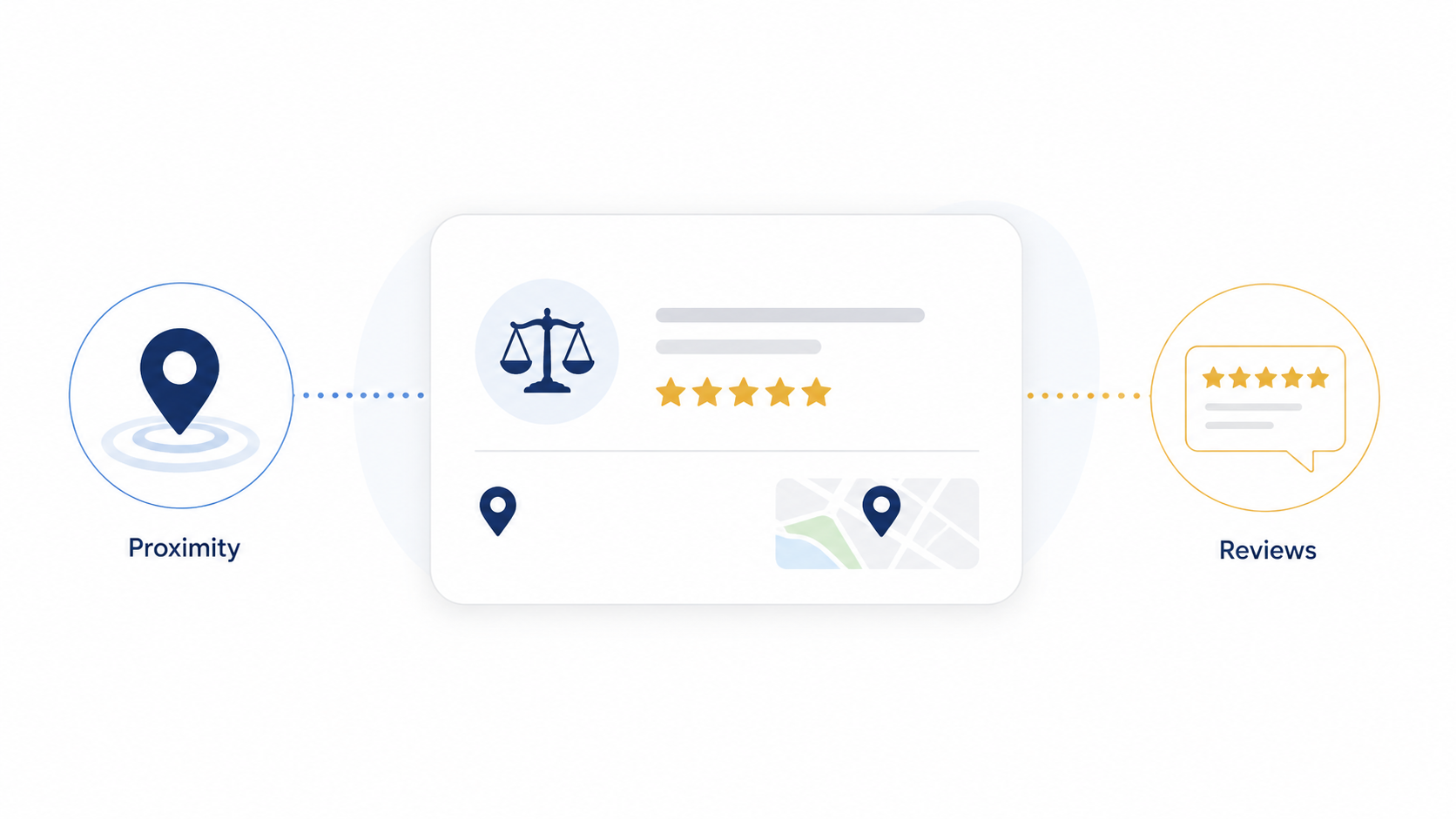
We analyzed the law firms appearing in the top three map pack positions for “business lawyer” and “business litigation lawyer” searches across New Jersey statewide, Newark, Paterson, and Jersey City. Across those searches, 19 distinct law firms appeared in the local pack.
This article explains what that analysis revealed about the top Google Maps ranking factors for law firms in 2026.
Why Does Google Business Profile Optimization Matter for Your Law Firm’s Local SEO?
Think about someone searching “business litigation lawyer near me” compared with someone searching “can an operating agreement help reduce disputes between LLC members?” The second person may still be researching. The first is much closer to contacting an attorney.
For local queries, the map pack can appear near the top of Google Search results, before the traditional organic results. If your law firm ranks there, you have a chance to reach that prospective client early in their search.
Your Google Business Profile also gives searchers enough information to start evaluating your firm. They can see your reviews and rating, check your location and hours, and view photos. If they are ready to act, they can call your firm directly from the profile, request directions, or visit your law firm’s website.
That is why your Google Business Profile should not be treated like a directory listing that you set up once and forget. An optimized profile can become a direct lead acquisition asset because it helps your firm appear when local prospects are actively looking for legal help.
How We Analyzed the 19 Law Firms in the Local Pack
We wanted to understand what the law firms already ranking in Google’s local pack had in common. To do that, we used Smoother Media’s Local SERP Checker to view Google search results from specific locations.
To identify the firms, we:
- Set the search location separately for New Jersey statewide, Newark, Paterson, and Jersey City.
- Searched for “business lawyer” and “business litigation lawyer” in each market.
- Recorded the law firms appearing in the top three map pack positions for each search.
- Removed duplicate appearances, leaving 19 distinct law firms for analysis.
We then reviewed each law firm’s Google Business Profile to look for patterns that could help explain their local visibility. For each profile, we checked:
- The firm’s total review count
- How recently the firm had received reviews and how consistently new reviews were coming in
- Whether the law firm responded to reviews and how regularly it did so
- How the reviews were worded, including whether reviewers mentioned specific legal services or the type of matter the firm handled
- Whether the firm was publishing posts on its Google Business Profile
The patterns we found do not prove that any single factor caused a particular law firm to rank in the local pack. They do show which profile characteristics appeared most consistently across firms already holding top-three positions.
You can read our full 2026 New Jersey Law Firm SEO Report for the broader findings from this research. TypeTopia Agency is not affiliated with any of the law firms included in this analysis.
What Did the 19 Law Firms Ranking in the Local Pack Have in Common?
Consistent New Reviews Were the Strongest Pattern
What was more consistent was ongoing review activity. Most firms were still receiving new reviews regularly, and 11 of the 19 were also responding to them. Based on our analysis, maintaining a strong rating and consistently earning new reviews is the most important Google Business Profile ranking signal a law firm can actively influence.
GBP Posting Was Uncommon Among Firms With Top-Three Local Pack Rankings
Only 4 of the 19 law firms were clearly publishing GBP posts. We found no visible posts for 12 firms. The remaining three showed activity on Facebook or other social media. That is a sharp contrast with the regular review activity we observed among the firms.
Based on our findings, if you are deciding where to spend your time on Google Business Profile optimization, earning consistent reviews should take priority over maintaining a frequent GBP posting schedule.
How to Optimize Your Google Business Profile for Local Search
Step 1: Claim and Verify Your Google Business Profile
Google determines which verification methods are available to your firm. Depending on the profile, you may be asked to verify by video, phone, email, or another method. Once verified, you can manage how your firm’s information appears across Google Search and Maps.
Step 2: Choose the Most Accurate Primary Category
Choose the category that most accurately describes your firm as a whole. You can add relevant secondary categories where they genuinely describe the firm, but do not add categories simply because they contain search engine optimization keywords you want to rank for.
Step 3: Complete Your Core Business Information
Do the same for the other relevant fields Google makes available to your firm. If someone finds you through local search, they should not have to leave your profile to figure out whether your contact information or office hours are correct.
Step 4: Add the Legal Services Your Firm Provides
Use those descriptions to explain the service in language a prospective client can understand. Naturally describe the type of legal problem the service addresses instead of filling the description with repetitive SEO keywords. Keep the descriptions consistent with the practice and service pages on your website.
Google can highlight a service on your profile when someone searches for an offering your business provides, so this is another place to make the connection between what your firm does and what someone may be searching for clear.
Step 5: Write a Clear and Useful Business Description
Write for the prospective client first. The description should accurately represent the firm rather than becoming a block of SEO keywords. Google specifically requires Business Profile descriptions to contain information that is relevant and useful to customers.
Step 6: Add Current, Useful Photos
Use real, current images of the firm rather than filling the profile with generic legal stock photography. Google recommends business-specific photos because they help customers understand the business they are considering.
Step 7: Build a Process for Earning New Reviews Consistently
Decide when it makes sense to ask a genuine client for a review, and make the request part of your normal client follow-up or matter-closing process. Google gives your firm a direct review link, so there is no reason to make the client search for your profile before they can leave feedback.
Do not offer an incentive in exchange for the review or ask only clients you expect to leave positive feedback. The review should come from a genuine client experience, and the client should be free to describe that experience in their own words.
How Can Your Law Firm Get a Direct Google Review Link?
Google lets you create a direct link that takes a client to the review flow for your Business Profile.
To get it:
- Open your law firm’s Google Business Profile while signed into the Google account that manages it
- Select ‘Read reviews’
- Click ‘Get more reviews’
- Copy the review link Google provides
- Add the link to the appropriate point in your client follow-up or matter-closing process
Google also provides a QR code from this area if you want to use the review request in printed materials. The client can use the direct link instead of searching for your law firm on Google first.
Step 8: Respond to Reviews Consistently
Keep the response useful and professional. For a law firm, you should also be careful not to disclose confidential information when responding publicly, even if the reviewer discusses their legal matter first.
Step 9: Use GBP Posts When You Have Something Useful to Share
But do not make frequent posting the center of your Google Business Profile optimization strategy. As our findings show, few of the firms we studied were clearly publishing GBP posts. If your time is limited, keep your profile accurate and focus first on earning legitimate reviews consistently.
How Your Law Firm Website Supports Local Visibility
Your profile also needs to reflect what prospective clients find on your website. If your profile says you handle a particular legal service, prospective clients should be able to find a dedicated page that clearly explains it when they click through. Our law firm practice area page guide explains how to build those pages for search visibility and qualified leads.
Your attorney bio pages should then make clear which lawyers handle that work and give prospective clients more information about the attorneys they may be contacting.
Want Help Optimizing Your Law Firm’s Google Business Profile?
At TypeTopia Agency, we help law firms improve their local search visibility through Google Business Profile optimization and broader law firm SEO services, legal content writing, website design, and technical SEO. We can audit your current profile, show you where the biggest opportunities are, and help you build a strategy focused on the signals that are most likely to move the needle.
Contact TypeTopia Agency or email us directly at inquiries@typetopiaagency.com to discuss your firm’s local visibility.
FAQ

What Should Your Law Firm Improve First?
A TypeTopia marketing audit helps you prioritize improvements to your website, content, and search visibility. You can also request a free discovery session to talk through your firm’s goals.
Found this useful? See more from TypeTopia Agency in Google.
Add TypeTopia Agency as a preferred source to tell Google you’d like to see more of our law firm marketing research and guides.