AI Visibility for Law Firms in 2026: What 13 Firms Recommended Across 5 AI Platforms Had in Common

Want to see more TypeTopia Agency research in Google?
Add TypeTopia Agency as a preferred source to tell Google you’d like to see more of our law firm marketing research and guides.
We traced the citations behind those AI recommendations and examined each cited page. We also checked how it connected to the wider site and what structured data was present.
This article shows what those firms had in common and what law firm owners can apply to improve AI search visibility across ChatGPT, Gemini, Perplexity and Google AI Overviews.
Want the full takeaway without reading the full analysis? Skip to the end to see the seven things the 13 firms that appeared across all five AI platforms in our 221-firm dataset had in common.
How We Analyzed AI Visibility for Law Firms
To measure AI visibility for law firms, we used the same two keywords from our Google search analysis: “business lawyer” and “business litigation lawyer.” Each keyword was turned into a natural-language prompt based on how a prospective client might ask an AI system for legal help:
- “I am a business owner in ‘LOCATION’ and need legal help with contracts, ownership issues, and major business decisions. Can you recommend a law firm?”
- “My ‘LOCATION’ business is facing a serious dispute involving a contract, ownership, or control. Can you recommend a law firm that handles business litigation?”
“LOCATION” was then replaced with four geographic areas:
- New Jersey statewide
- Paterson
- Newark
- Jersey City
The prompts were tracked for five days through Surfer AI Tracker across:
- Google AI Overviews
- Google AI Mode
- ChatGPT
- Perplexity
- Gemini
The resulting dataset contained 1,285 AI recommendation rows, 414 citation records, and 221 distinct law firms.
If you want to see the full methodology, including how traditional search results and AI visibility were measured across the study, read the full 2026 New Jersey Law Firm Visibility Report here.
The 13 Law Firms TypeTopia Agency Analyzed
Of the 221 law firms identified in the study, 13 appeared across all five AI platforms we tracked. Together, these firms accounted for 495 AI recommendation rows, and they form the basis of this analysis because we wanted to see whether the pages and sources supporting their recommendations shared patterns across different AI systems.
They are:
- Dunn Lambert, LLC
- McLaughlin & Nardi
- Ehrlich, Petriello, Gudin, Plaza & Reed
- Sills Cummis & Gross
- Greenbaum, Rowe, Smith & Davis
- McCarter & English
- Gibbons
- Pashman Stein Walder Hayden
- Lowenstein Sandler
- Cole Schotz P.C.
- Riker Danzig LLP
- Connell Foley
- Stark & Stark
TypeTopia Agency is not affiliated with, endorsed by, or associated with any of the law firms listed above. Our analysis was conducted independently using publicly available websites, search results, AI outputs, and third-party SEO and visibility tools. Inclusion in this article reflects the results of our study during the observation period and should not be interpreted as an endorsement or assessment of legal services.
You can also see what we found when we analyzed the law firm SEO ranking factors surrounding the three firms that appeared across Google Search, the Local Pack, and AI.
For a closer look at the Local Pack specifically, our Google Maps ranking factors for law firms analysis examines the 19 firms that appeared in the top three positions across the local searches in our study.
What Law Firm Pages Do AI Engines Cite?
Of those 235 citations, 144, or 61.3%, pointed to a law firm’s own website. The remaining 91, or 38.7%, pointed to third-party sources. Twelve of the 13 firms had at least one third-party legal directory or ranking platform among their cited sources, while six had no firm-owned citation in our dataset.
When AI systems did cite a law firm’s website, practice area and service pages accounted for most of those citations. We identified 20 distinct firm-owned URLs, and 18 were practice area or service pages. Across all 144 firm-owned citation records, 121, or 84%, pointed to those pages rather than a homepage.
The remaining 22 firm-owned citation records, or 15.4%, pointed to just two law firm homepages. Dunn Lambert’s homepage accounted for 20 of those citations and appeared as a cited source across all five AI environments. Ehrlich, Petriello, Gudin, Plaza & Reed’s homepage accounted for the other two, appearing once in AI Mode and once in ChatGPT.
Those 143 firm-owned citations represented 20 distinct URLs: 18 practice area or service pages and two homepages.
Firm-owned and third-party sources also appeared together within individual AI recommendations. Twenty-five of the 178 cited recommendations, or 14%, included both types of source in the same answer. In some cases, a firm’s practice area page appeared alongside a source such as Justia or Chambers.
That does not show that one source caused the other to appear. It does show that AI systems sometimes supported the same law firm recommendation with information from the firm’s website and an independent legal source. For your firm, both parts of that visibility are worth examining.
Practice Area Pages Were the Most Common Firm-Owned AI Engine Citations
We then looked more closely at the practice pages themselves. Our crawl analysis covered 17 pages across six law firms. We excluded the two homepages because this part of the study focuses on practice-area structure. Riker Danzig’s cited Litigation page was also excluded because the website blocked our crawl.
Specific Matter Pages Matched the Problems Described in AI Queries
AI Engines Cited Broad Practice Pages and Specific Legal Problems
The clearest example came from McLaughlin & Nardi.
Our business litigation prompt told the AI that the business was facing a serious dispute involving “a contract, ownership, or control.” McLaughlin did not have just one general Business Litigation page trying to cover all of that. Its website broke ownership disputes into several distinct pages:
- Disputes Between Owners
- Partnership Litigation
- Shareholder Litigation & Shareholder Disputes
- LLC Disputes and Litigation
All four appeared among the firm’s AI-cited pages.
The same pattern appeared elsewhere. When the prompt involved contracts, Dunn Lambert’s Contract Law page appeared in the citation set. Ehrlich Petriello’s Breach of Contract page was cited for business litigation queries, while its broader Corporate & Business Law page appeared when the request called for more general business legal help.
| What the business owner told the AI | Page the AI cited |
|---|---|
| “I need legal help with contracts…” | Dunn Lambert, Contract Law |
| A serious dispute involving a contract | Ehrlich Petriello, Breach of Contract |
| A dispute involving ownership or control | McLaughlin & Nardi, Disputes Between Owners |
| A dispute involving business partners | McLaughlin & Nardi, Partnership Litigation |
| A shareholder ownership dispute | McLaughlin & Nardi, Shareholder Litigation & Shareholder Disputes |
| An LLC ownership dispute | McLaughlin & Nardi, LLC Disputes and Litigation |
| Broader help with major business decisions | Ehrlich Petriello, Corporate & Business Law |
In some recommendations, AI systems cited more than one McLaughlin page from the same practice structure in support of the same firm recommendation.
That does not prove that creating more narrow practice pages will cause an AI system to recommend your firm. It does show that AI search visibility was not confined to the page targeting the broadest keyword.
For your firm, the practical question is whether your website can answer both levels of the search.
If a prospective client asks for a business litigation lawyer, can an AI system find the broad practice? If that same person describes a shareholder dispute or a contract problem instead, is there a page on your website that clearly represents that specific matter?
That is where the structure of the cited law firm websites becomes much more interesting.
AI-Cited Practice Area Pages Sat Inside Clear Topical Structures
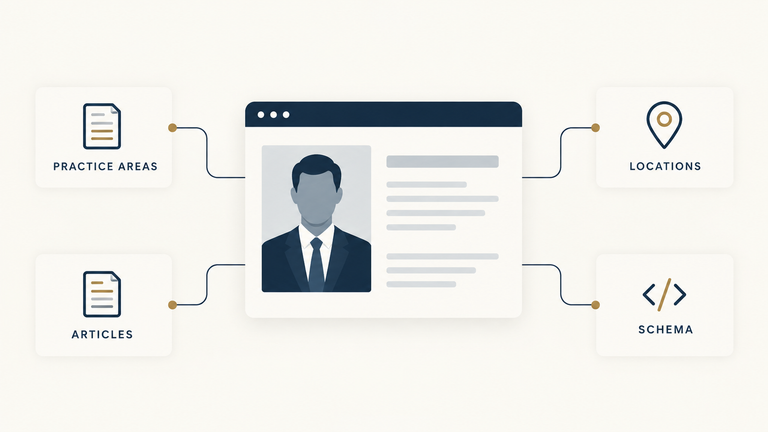
The pages were connected to broader practices, narrower legal problems, or other parts of the firm website that helped search engines and AI systems understand what the firm handled.
The differences are easier to see in the crawl data:
| Firm | What the cited practice structure looked like | What we found in the crawl |
|---|---|---|
| McLaughlin & Nardi | Ownership-disputes hub connected to narrower dispute pages | The cited Disputes Between Owners page linked directly to Partnership Litigation, Shareholder Disputes, and LLC Disputes. Those child pages linked back into the same structure, and all four pages appeared in the AI citation data. |
| Ehrlich Petriello | Broad practice hubs connected to specific legal problems | Commercial Litigation received contextual links from 34 different pages. Corporate & Business Law received them from 25. Narrower cited pages such as Breach of Contract and Business Disputes were connected back to those broader practices. |
| Pashman Stein | Litigation hub tied closely to the firm’s attorneys and content | 52 attorney profiles linked into the Litigation page. The page linked out to 55 team profiles and a large library of litigation-related news and firm content. |
| Greenbaum | Litigation hub connected to attorneys, related practices, and insights | 26 attorney profiles linked into Litigation, while the page linked to 39 attorneys. It also connected to 23 other practice pages and 42 News & Insights URLs. |
| Stark & Stark | Broad Business hub leading into a more specific Litigation practice | The Business page connected reciprocally with 25 child business practices. Its cited Litigation page linked to 19 attorney profiles, and 10 of those attorneys linked back to Litigation. |
| Dunn Lambert | Smaller contract-law cluster | Contract Law linked to its Business Transactions parent and to Contract Disputes. Four contract-related articles also linked contextually into the cited page. |
The scale was very different. Pashman built a large network around Litigation, while Dunn Lambert’s Contract Law page sat inside a much smaller group of closely related pages. McLaughlin’s narrower ownership-dispute pages also had relatively few contextual inlinks.
To understand those structures, we looked at links in both directions. An inlink is an internal link from another page on the firm’s website into the page being analyzed. An outlink is a link from that page to another page on the same website.
The direction matters because it shows how a practice area page fits into the rest of the site. A broader practice page can send an outlink to a more specific matter page. From the specific page’s perspective, that same connection is an inlink. When the narrower page links back to its parent or across to a related matter, the relationship becomes visible in both directions.
McLaughlin & Nardi gives us the clearest example. Its website breaks ownership disputes into separate matters and connects those pages to one another.
↓ outlinks to
Partnership Litigation
↔ Shareholder Litigation & Shareholder Disputes
↔ LLC Disputes and Litigation
The Disputes Between Owners page sends internal outlinks to each of those narrower matters. Those child pages receive the links as inlinks and also connect back into the ownership-dispute structure. The pages therefore do more than cover similar subjects. Their internal links explicitly show how partnership, shareholder, and LLC disputes relate to the broader ownership-disputes practice.
All four pages appeared as firm-owned AI citations.
Stark & Stark used a different structure. Its cited Business & Commercial Services page sends outlinks to 25 child business practices, including Business Litigation. The Business Litigation page then sends outlinks to 19 attorney profiles. Ten of those attorney pages also link back to Business Litigation, creating inlinks into the practice page from the lawyers associated with the work.
↓ outlink to child practice
Business Litigation
↓ outlinks to attorneys
Attorneys who handle Litigation
↑ 10 attorney profiles link back
Both the Business page and the Business Litigation page appeared as firm-owned AI citations. In this structure, the parent page places Litigation within the firm’s broader business offering, while the links between Litigation and the attorney profiles connect the service to the people who handle it.
We also saw AI systems cite multiple connected pages from the same firm in a single recommendation. McLaughlin & Nardi had 11 recommendations in which two or more firm-owned pages appeared together as cited sources. Disputes Between Owners and Partnership Litigation appeared together five times, while Small Businesses & Contractors and Business Law appeared together four times.
In one Jersey City Business Law AI Overview, the cited sources included McLaughlin’s Disputes Between Owners, Partnership Litigation, and Small Businesses & Contractors pages in the same answer.
Our study cannot establish that the internal-link structure caused those pages to be retrieved together. The citation behavior does show that AI search sometimes drew on several pages from the same firm’s coverage of a legal topic when supporting one recommendation.
For your law firm, the practical question is whether the inlinks and outlinks around a practice page make its place in the wider practice understandable. A prospective client may describe a shareholder dispute without ever searching for “business litigation.” Your website should make the connection between that specific matter and the broader legal service visible through the way those pages link to one another.
Internal-Link Relevance Was More Consistent Than Internal-Link Volume
What became more useful was looking at where the inlinks came from and where the page’s outlinks led. Links from a parent practice, a related legal matter, an attorney who handles the work, or supporting content communicated something about the page’s role in the firm’s wider practice. A repeated navigation link served a different purpose.
| Example | What the internal-link data showed |
|---|---|
| Pashman Stein Litigation | 123 content inlinks from 107 unique pages, including 52 attorney profiles and 33 news or recognition pages |
| Greenbaum Litigation | 46 content inlinks, including links from 26 attorney profiles and 11 News & Insights pages |
| Ehrlich Commercial Litigation | 881 raw inlinks, but only 41 were contextual once repeated navigation was separated |
| McLaughlin narrow dispute pages | Relatively few contextual inlinks, but they came from closely related parent and sibling pages |
| Dunn Lambert Contract Law | Only a small number of page-specific contextual inlinks, including its Business Transactions parent, Contract Disputes, and relevant contract articles. |
The more consistent feature was topical relevance. The links surrounding the cited page tended to explain how it related to the firm’s services, attorneys, or supporting coverage of the same legal issue.
This distinction mattered most on sites with large repeated navigation systems. Ehrlich’s Commercial Litigation page, for example, showed 881 total inlinks in the crawl. Once navigation and other reusable site elements were separated, only 41 were contextual links from 34 different pages.
Counting all 881 as equivalent would have made the page look far more internally supported than it actually was in the body content. That is why our analysis separates sitewide navigation from contextual links and parent-child relationships.
The anchors also tended to describe the relationship clearly. A parent page might link to “Partnership Litigation” or “Shareholder Disputes,” while supporting content could use a more contextual phrase about contracts or ownership disputes. Exact-match repetition was not universal. What mattered more for our analysis was whether the link made the destination’s relevance understandable.
For your law firm, the goal should not be to manufacture a target number of internal links to every practice area page. Review the pages linking into it and the pages it links out to. Those connections should help a reader, a search engine, or an AI system understand where the service sits within the rest of your firm’s work.
Attorneys and Supporting Content Reinforced Practice Areas in Different Ways
| Firm / cited page | Attorney relationship we found |
|---|---|
| Pashman Stein, Litigation | 52 attorney profiles linked into the practice page, while the page linked to 55 team profiles |
| Greenbaum, Litigation | 26 attorney profiles linked into Litigation, and the page linked to 39 attorneys |
| Stark & Stark, Business Litigation | The page linked to 19 attorney profiles, with 10 of those attorneys linking back |
| McLaughlin narrow ownership-dispute pages | The specific Partnership, Shareholder, and LLC pages did not directly link to individual attorney bios |
| Dunn Lambert, Contract Law | No direct individual-attorney relationship in the body; the page instead sat inside the firm’s contract/service structure |
| Firm | Supporting-content structure |
|---|---|
| Pashman Stein | Litigation connected to a very large body of news, publications, and other firm material |
| Greenbaum | Litigation linked to 42 News & Insights URLs, while 11 News & Insights pages also linked into the practice |
| Stark & Stark | Business practices were supported by related firm news and other pages within the business-services structure |
| McLaughlin & Nardi | Practice pages connected into the firm’s broader business-law content and New Jersey Lawyers Blog |
| Dunn Lambert | Four contract-related articles provided contextual inlinks into Contract Law |
For your law firm, the takeaway is to link attorney bios, relevant articles, news, and other supporting resources to the practice page they reinforce, and link back from the practice page where that content helps explain the service in more depth. The goal is to make the relationship between the firm’s legal content and its commercial practice pages clear.
Structured Data and Schema Markup
Schema markup gives search engines and AI systems machine-readable information about your firm, your pages, and the relationships between them. See our guide on schema markup for law firms for more information.
| How the schema worked | Firms in our sample | What it communicated |
|---|---|---|
Practice-specific Service markup | Greenbaum | Defined the practice itself and connected it to the law firm |
| Page + practice hierarchy | McLaughlin & Nardi | Identified the page and used breadcrumbs to preserve its place in the practice structure |
Firm-level LegalService markup | Dunn Lambert, Ehrlich Petriello, Riker Danzig | Primarily described the law firm or office rather than the individual practice |
| Organization markup | Pashman Stein | Identified the firm without separately defining the cited litigation practice |
WebPage, while its breadcrumb schema preserves the same practice hierarchy we found during the crawl:Practice Areas
↓
Business Services Practice
↓
Business Law, Planning, Services, Counsel, Transactions & Litigation
↓
Disputes Between Owners
↓
Partnership Litigation
Its Shareholder Disputes and LLC Disputes pages follow the same hierarchy.
Greenbaum took a more explicit approach. Its schema identifies Litigation as a
Service provided by the firm and connects that broad practice to more specific litigation services.Ehrlich Petriello used a less specific implementation across five cited practice pages. The same general
LegalService markup described the law firm rather than separately defining services such as Breach of Contract or Shareholder Disputes. Pashman Stein’s cited Business & Commercial Litigation page was simpler still, with structured data identifying the organization rather than the individual practice.Practice-specific
Service or LegalService markup was not a shared characteristic of the AI-cited practice pages.For your law firm, our data does not support treating one schema type as a requirement for AI visibility. The cited pages appeared across several implementations, including pages without practice-specific
Service markup.The more useful approach is to make sure your structured data accurately reflects what is already on your website. The markup should correctly represent the practice page and its relationship to the firm, while breadcrumb schema can preserve where the page sits within a wider practice structure.
Third-Party Legal Platforms Also Appeared in AI Citations
Many of these sources operate as commercial legal directories, ranking platforms, or professional-services marketplaces. Law firms may pay for enhanced profiles, advertising, sponsorships, or other forms of visibility on some of them.
Which Third-Party Sources Did AI Systems Cite?
| Third-party source | Citation records | Firms supported | Type of source |
|---|---|---|---|
| Justia | 24 | 2 | Legal directory and legal information platform |
| Chambers | 22 | 8 | Legal ranking and research platform |
| Super Lawyers | 21 | 5 | Attorney rating and directory platform |
| Expertise | 13 | 1 | Professional-services directory and ranking platform |
| LawFirmSquare | 6 | 5 | Legal directory |
| Best Lawyers | 3 | 2 | Legal ranking and recognition platform |
| Cornell | 2 | 1 | Legal reference source |
Chambers appeared 22 times and supported eight of the 13 firms. Its New Jersey General Commercial Litigation page appeared in recommendations involving Sills Cummis, Greenbaum, McCarter & English, Gibbons, Pashman Stein, Lowenstein Sandler, Cole Schotz, and Riker Danzig.
Those numbers show two different kinds of third-party visibility. A platform can appear frequently around a small number of firms, or the same page can appear across recommendations involving many different firms.
AI Systems Sometimes Cited the Firm Website and a Third-Party Source Together
Of the 178 recommendations in this group that contained at least one recorded citation, 25, or 14%, included both a firm-owned source and a third-party source in the same AI-generated answer.
McLaughlin & Nardi provides one example. In some recommendations, one of the firm’s own practice pages appeared alongside a Justia or Cornell source.
This shows that an AI recommendation can be supported by information coming from different parts of the web at the same time. The firm’s website may describe the legal service directly, while another source places the firm within a broader practice, location, or legal-information context.
The study cannot determine whether one source caused the other to appear.
Six Firms Appeared Without a Firm-Owned Citation in Our Dataset
That does not tell us that their websites were unimportant. We can only analyze the sources recorded with the AI-generated answers.
It does show that an AI system can recommend a law firm while citing a third-party page instead of the firm’s own website.
What Law Firms Should Focus on for AI Visibility in 2026
Our study revealed several recurring factors among the 13 firms that appeared across all five AI platforms in our 221-firm dataset:
- Strong practice-area pages. Practice and service pages accounted for 18 of the 20 distinct firm-owned URLs AI systems cited, and 84% of all firm-owned citation records. Your firm should make sure the practices you actually want work from have clear, substantial pages of their own. See how TypeTopia Agency can build and optimize your practice area page.
- Pages for specific legal problems. AI systems cited both broad service pages and narrower pages focused on the actual issues a prospective client might describe. For your firm, that means important matters should have their own pages when they represent a distinct type of work, rather than forcing every problem into one broad practice page.
- Clear topical structure. The cited pages usually had an identifiable relationship to the rest of the firm’s coverage of that legal service. Connect broad practices, narrower matters, and related pages in a way that reflects how the work actually fits together.
- Relevant internal links, not a target number. Internal-link volume varied too widely to produce a useful benchmark. Focus on whether the pages linking in and out help explain the relationship between a practice page and the firm’s related services.
- Attorney and supporting-content connections. Some broad practice hubs were strongly connected to attorney profiles and large content libraries, while narrower pages relied more heavily on parent practices and closely related matters. Link the attorneys who actually handle the work and connect relevant articles or news to the commercial pages they support.
- Accurate structured data. Schema was present across the firm-owned URLs we validated, but no single implementation was shared by the cited pages. Use schema to represent the page and its place in the website accurately rather than treating one schema type as an AI visibility requirement.
- Third-party visibility. Third-party sources accounted for 38.7% of the citation records in this group, and 12 of the 13 firms had at least one third-party citation. Monitor the directory, ranking, and legal-information pages that associate your firm with the practices and locations you want to be known for.
Build the Same AI Visibility Foundation for Your Law Firm
TypeTopia Agency can apply the same framework we used in this study to your law firm. We start by auditing your website against the factors we found across the 13 firms that appeared on all five AI platforms, then identify what is missing, what needs to be strengthened, and what should be connected more clearly.
Depending on what your firm already has, we can:
- Audit your practice area pages to see whether they clearly represent the legal services you want to be known for and how well they align with search and AI visibility best practices.
- Write or rebuild core practice area pages when important services are missing, too thin, or trying to cover too much on one page.
- Create pages for specific legal problems your prospective clients are likely to search for or describe to an AI system, such as particular disputes, transactions, or other matters within a broader practice.
- Write and optimize attorney bios so your website clearly connects the lawyers at your firm with the practices and matters they actually handle.
- Strengthen on-page SEO across those pages so they are built for traditional search as well as the way people now search through AI systems.
- Handle the technical SEO and structured data behind the site, including schema markup that accurately represents your firm, attorneys, practice areas, and page relationships.
- Build the internal-link structure connecting practice pages, specific matters, attorney bios, and supporting content so the relationships between them are clear across the website.
- Publish and format the pages on your website so the finished content is not sitting in a document waiting for someone else to implement it. We can take it through to a polished, usable page on the live site.
The goal is to leave your firm with more than a collection of optimized pages. We build a website structure that clearly represents what your firm does, the specific problems you solve, who handles that work, and how those services relate to one another.
If you want to know where your current website stands, start with a TypeTopia Agency law firm marketing audit. We can identify the gaps first, then help you build the pages, technical foundation, and internal structure needed to strengthen your visibility across search and AI. Or email us at inquiries@typetopiaagency.com and tell us what your firm needs.
Frequently Asked Questions About AI Visibility for Law Firms
How can I tell whether my law firm is visible in AI search?
For example, test questions that combine the legal problem, the service, and the market you want to serve. Then run the same questions across ChatGPT, Gemini, Perplexity, Google AI Overviews, and AI Mode.
Record whether your firm is recommended, which competitors appear, what position your firm receives when a list is given, and which sources the AI cites. Repeat the same set of prompts over time so you can see whether your visibility is improving rather than relying on a single AI answer.
What should I do if AI recommends competing law firms but not mine?
Look at the practice pages it cites, the specific legal problems those firms have pages for, how their practice pages connect to attorneys and supporting content, and which third-party directories or ranking pages mention them.
Then compare that coverage with your own firm. You may find that you handle the same matter but have no page clearly describing it, that an important practice page is isolated from the rest of your website, or that competitors are represented on third-party pages where your firm is absent.
The goal is to identify the visibility gap, not simply copy the competing firm’s website.
How do I decide which practice area or legal problem pages to build first?
For each major practice, list the distinct problems clients regularly bring to you. Then check whether each important problem is clearly represented somewhere on your website.
A business litigation firm, for example, may handle shareholder disputes, partnership disputes, breach of contract, LLC disputes, and other matters. Those problems should not automatically become separate pages, but a dedicated page makes sense when the matter is commercially important, meaningfully different from the broader practice, and substantial enough to answer on its own.
Our citation data supports looking beyond broad practice terms. AI systems cited both broad practice pages and pages focused on specific legal problems described in the user’s query.
Does my law firm need a separate SEO strategy for ChatGPT, Gemini, Perplexity, and other AI platforms?
The underlying foundation is largely shared: clear legal-service pages, specific matter coverage where appropriate, strong internal relationships between pages, accurate attorney information, useful supporting content, crawlable technical infrastructure, structured data, and accurate third-party representation.
What should be platform-specific is monitoring. ChatGPT, Gemini, Perplexity, Google AI Overviews, and
AI Mode do not necessarily recommend the same firms or cite the same sources.
Build one strong search and AI visibility foundation, then measure how that foundation performs across each platform.
Should my law firm pay for legal directories to improve AI visibility?
In our study, third-party legal platforms appeared repeatedly in AI citations. Justia, Chambers, Super Lawyers, Best Lawyers, and other sources were used to support law firm recommendations. Justia and Best Lawyers also appeared prominently in the Google organic results we analyzed, which means these platforms can put your firm in front of prospective clients across more than one search environment.
How often should a law firm monitor its AI visibility?
Use a consistent set of prompts covering the practices, legal problems, and locations that matter to your firm. Track the same questions across multiple AI platforms so changes are comparable.
You should also recheck visibility after major changes to your website, such as launching a new practice area, adding a group of matter pages, rebuilding attorney bios, changing URLs, or completing a major SEO project.
The important part is consistency. AI answers can change, so one search on one day should not become your measure of whether the strategy is working.
How can I tell whether AI visibility is producing qualified leads for my firm?
Ask every prospective client how they found the firm and give them an opportunity to specify ChatGPT, Gemini, Perplexity, Google AI, or another AI tool. When possible, ask what they searched or what the AI told them about the firm.
Then track those inquiries through to consultations and signed matters. The useful metrics are not simply how often your firm appears in AI results, but how many qualified inquiries and new matters can be connected to that visibility.
You can also monitor referral traffic from AI platforms where it is available, branded searches, contact-form submissions, calls, and increases in direct traffic. Those signals can provide context, but your intake and CRM data will usually give you the clearest connection between AI visibility and actual business.
Ultimately, the goal is not to become the law firm that appears in the most AI answers. It is to become visible for the questions asked by the prospective clients and matters your firm actually wants.
Found this useful? See more from TypeTopia Agency in Google.
Add TypeTopia Agency as a preferred source to tell Google you’d like to see more of our law firm marketing research and guides.