How to Build a Law Firm Homepage That Converts: What Ranking and AI-Cited Law Firm Homepages Have in Common
Want to see more TypeTopia Agency research in Google?
Add TypeTopia Agency as a preferred source to tell Google you’d like to see more of our law firm marketing research and guides.
To see what that looks like in practice, we analyzed law firm homepages that appeared on page one of Google or were cited by AI tools for business lawyer and business litigation lawyer searches across four New Jersey markets.
This guide shows where those pages overlapped and where they differed, then uses those findings to help you build a law firm homepage that works better for the qualified leads you want to reach.
What Law Firm Owners Should Prioritize on Their Homepage
- Make the top of your homepage explain your firm quickly. A qualified visitor should be able to understand who you help and the kind of legal work you handle without searching through the website. See how to structure your homepage opening.
- Use your SEO title, meta description, and H1 for different jobs. Your title can establish your service and market, while the visible heading and supporting copy give the visitor more context. See how to structure your homepage SEO elements.
- Make your important practice areas easy to find. Use service cards, a carousel, contextual links, or another format that lets a prospective client move quickly to the legal service that matches their problem. See how to present your practice areas.
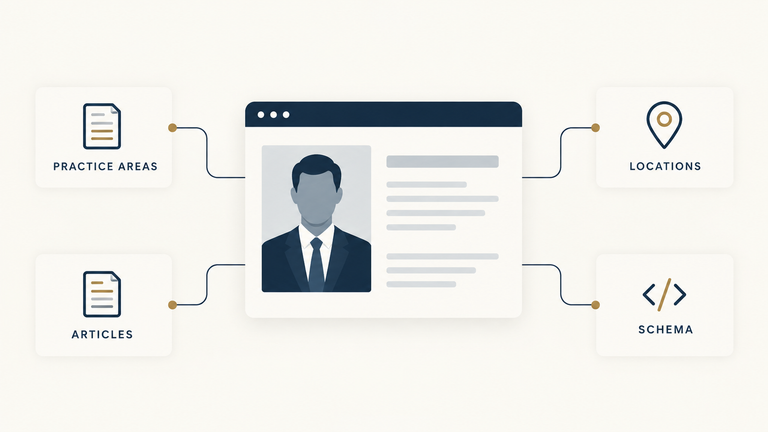
- Show prospective clients who is behind the firm. Feature relevant attorneys on the homepage and link them to individual bio pages where visitors can learn more about their experience. See how to feature attorneys on your homepage.
- Keep contact information and the next step visible. Your phone number, consultation option, or primary contact action should not be buried on a separate page. See how to make it easy for visitors to contact your firm.
- Use structured data that reflects the page you actually built. Schema can help machines understand the firm and the entities represented on the homepage, but it should match the visible content rather than copy another firm’s markup. See how to approach homepage schema.
How We Analyzed Ranking and AI-Cited Law Firm Homepages
The homepages in this guide came from our 2026 New Jersey Law Firm Visibility Study. We tracked business law and business litigation searches across New Jersey statewide, Newark, Jersey City, and Paterson.
For the AI portion, we ran matching prompts once a day for five days across Google AI Overviews, Google AI Mode, ChatGPT, Gemini, and Perplexity. You can read the full report and methodology here.
When we looked at the pages AI tools cited from law firm websites, practice area and service pages received most of the attention. They accounted for 121 of 144 firm-owned citation records, or 84%. Homepages accounted for the remaining 23 citations, or 16%. Only two individual homepages appeared in the AI citation set: Dunn Lambert and Ehrlich, Petriello, Gudin, Plaza & Reed.
In Google organic search, five individual law firm homepages appeared on page one a combined 14 times across the business lawyer and business litigation lawyer searches. Dunn Lambert appeared six times, Cohen Schneider Law and The Linden Law Group appeared three times each, and Quinn Emanuel and the Law Offices of John M. Shari appeared once each.
We combined those five Google-visible homepages with the two homepages that appeared in our AI citation data. Dunn Lambert appeared in both groups, while Ehrlich, Petriello, Gudin, Plaza & Reed appeared only in the AI citation set. That left us with six unique homepages to analyze:
- Firm A: Dunn Lambert, LLC
- Firm B: Cohen Schneider Law, P.C.
- Firm C: The Linden Law Group, P.C.
- Firm D: Quinn Emanuel Urquhart & Sullivan, LLP
- Firm E: Law Offices of John M. Shari, Esq.
- Firm F: Ehrlich, Petriello, Gudin, Plaza & Reed P.C.
For each law firm’s website, we reviewed how the homepage explained the firm’s legal services and represented its practice areas. We recorded geographic signals, title tags and headings, attorney placement, internal links, substantive website content, structured data, and how the homepage connected to deeper practice pages.
TypeTopia Agency is not affiliated with or endorsed by any of the law firms in this analysis. We are using their publicly available websites only to study patterns in search and AI visibility. From this point forward, we refer to them as Firms A through F so the focus stays on what you can learn from the homepages rather than on the individual firms.
What Did We Find on the Law Firm Homepages?
Finding 1: The Homepages Used the Top of the Page to Establish Relevance in Different Ways
| Firm | What the homepage leads with | What the visitor understands |
|---|---|---|
| Firm A | Business law and New Jersey | What the firm does and where it practices |
| Firm B | Entrepreneurs and business clients | Who the firm is built to help |
| Firm C | Business litigation and specific disputes | What legal problems the firm handles |
| Firm D | Recognition and litigation reputation | How the firm positions itself in the market |
| Firm E | Solo attorney and office location | Who the lawyer is and where the practice is based |
| Firm F | Brand positioning, followed by geography and audience | Where the firm practices and who it serves |
What This Means for Your Law Firm Homepage
If you run a focused business litigation practice, that may be the type of dispute you handle. If you are a solo attorney, your name and experience may deserve more prominence. A broader firm may need to establish who it serves before sending visitors into individual practice areas.
Your opening does not need to explain everything about your firm. It should give the right visitor enough information to decide whether they should keep reading.
Generic statements such as “trusted counsel” or “committed to excellence” can support your firm’s brand, but they should not be the only information a potential client gets at the top of the page.
Finding 2: Your Homepage and Practice Area Pages Can Support the Same Legal Service
A dedicated practice area page did not make the homepage irrelevant. Several firms in our Google data ranked with their homepage even though the website also had a page devoted to the legal service behind the search.
We saw something similar in the AI citation data:
- Firm A: In one Google AI Mode response for a statewide business law prompt, the AI cited both the firm’s homepage and its Contract Law page.
- Firm F: AI Mode and ChatGPT both produced responses where the firm’s homepage appeared alongside its Corporate & Business Law page.
That shows that search engines and AI tools can treat more than one page on your law firm website as relevant to the same legal service.
What This Means for Your Law Firm Homepage
If business litigation is one of your main practice areas, you do not need to choose between explaining it on your homepage and creating a dedicated business litigation page. Give each page a different job.
- Your homepage should make it clear that your firm handles the service and connect the visitor to the appropriate practice page.
- Your practice area page should go deeper into the legal work, the types of matters you handle, and what a prospective client needs to know.
- Link the pages to each other. Your homepage should link to the dedicated practice area page, and that practice area page should link back to your homepage. This creates a clear two-way relationship between the broader firm page and the more specific legal service page.
Your homepage should contain enough information for someone to understand that the service is part of your firm. The dedicated page can then provide the detail without forcing you to duplicate the same content across both pages.
Finding 3: Your Homepage Should Present Your Practice Areas
Each law firm homepage we reviewed gave visitors a way to understand or reach the firm’s legal services. In most cases, this happened in the upper half of the page. The format varied:
- Some firms used a practice area carousel near the top of the page.
- Others used service cards with short descriptions after the firm’s introduction.
- Some included practice areas contextually within the homepage copy.
- Others used navigation to lead visitors to dedicated practice area pages.
What This Means for Your Law Firm Homepage
You can use a carousel, service grid, short service sections, broader practice categories, or clear navigation to present your legal services.
The format should fit your law firm website. What matters is that your important practice areas are visible and easy to reach.
Finding 4: Use Your SEO Title to Identify Your Firm and Location, Then Add Context in the Meta Description
The meta descriptions then added more context about the firm. Depending on the homepage, that included the legal services offered, the clients served, specific types of matters, or contact information.
What This Means for Your Law Firm Homepage
Then use the meta description to tell the prospective client a little more. You might explain who you help, mention an important practice area, describe the type of legal work you handle, or give them your contact information.
Finding 5: Your Homepage Should Help Visitors Understand Who Is Behind the Firm
Four of the six homepages we reviewed, or 67%, gave visitors exposure to at least one specific attorney.
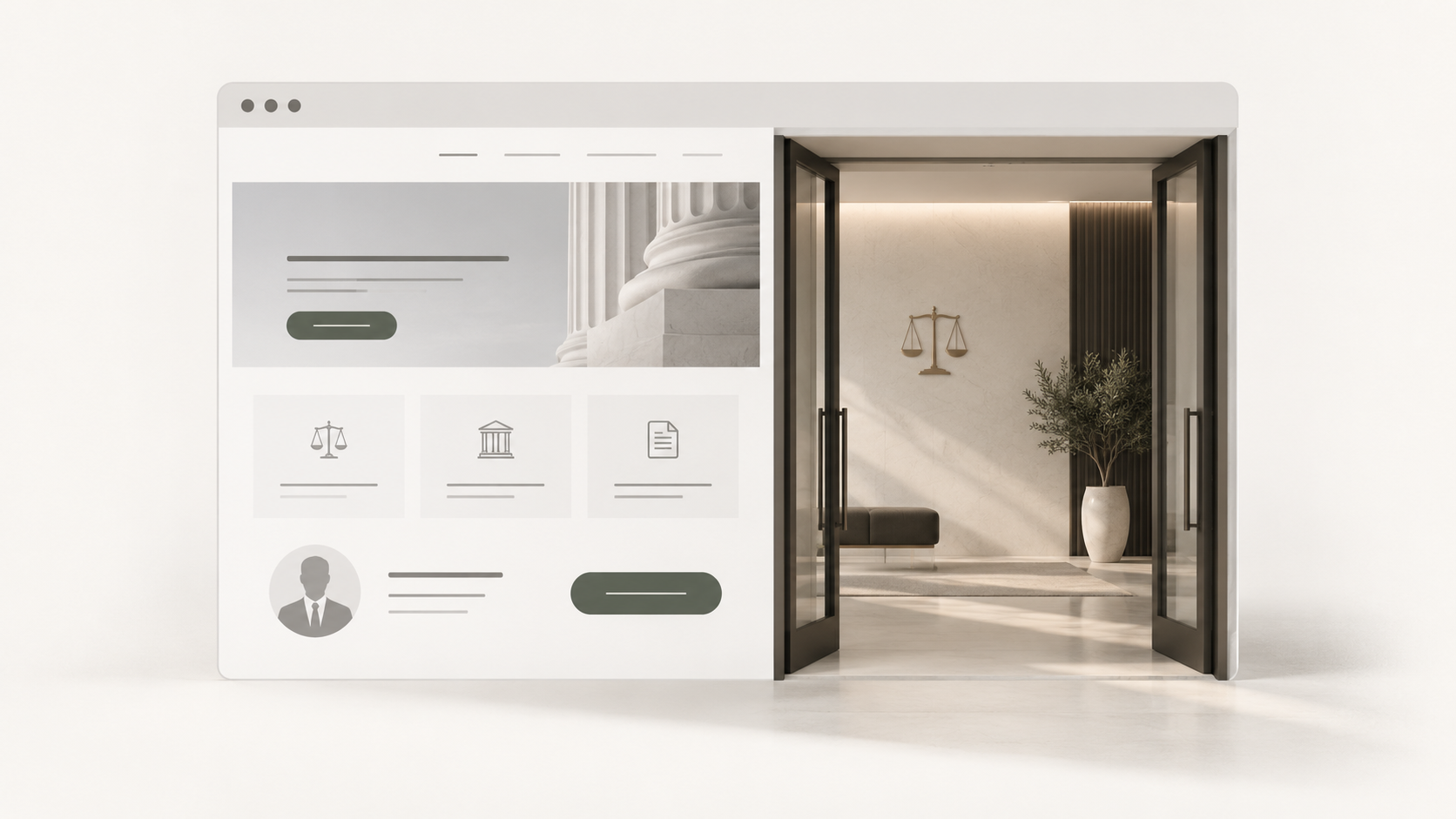
That makes sense. Your homepage is your firm’s online lobby. Along with showing potential clients what legal services you provide, it should help them understand who they may be working with.
You can do that in different ways:
- Feature attorneys in a sidebar or dedicated team section.
- Use attorney cards or a carousel.
- Mention attorneys naturally within the homepage copy.
- Link their names to individual attorney bios where visitors can learn more, and link those attorney bio pages back to the homepage so there is a clear two-way relationship.
Finding 6: There Was No Single Schema Type Across the Visible Homepages
Firm A and Firm F used
LegalService. Firm C used WebPage, while Firm D included broader page and organization markup. Firm E used Article and CreativeWork. We did not find JSON-LD on Firm B’s homepage.That variation matters because these pages still appeared in Google or were cited by AI despite using different schema types.
What This Means for Your Law Firm Homepage
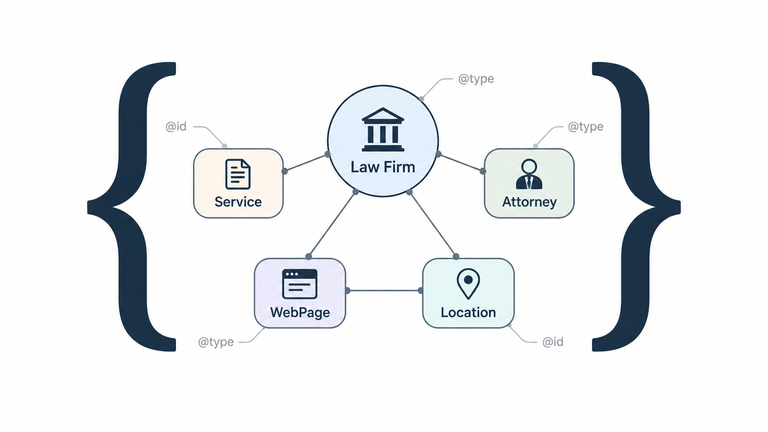
Your markup should reflect what is actually on the page. That might include your law firm, the webpage itself, individual attorneys, office locations, or other relevant entities.
There was no single schema type shared across all six homepages, so the data do not support treating one specific type of schema as a requirement for homepage visibility.
How to Build a Law Firm Homepage That Ranks and Converts
Start With an SEO Title That Names Your Practice Area and Location
Your SEO title is one of the clearest places to tell searchers what your firm does and where you practice. In our sample, five of the six homepages included a geographic reference in the title, and most also identified the firm’s broader legal focus.
Keep the title descriptive. Lead with the practice area you want the homepage associated with and the market you serve. Then include your firm name so the result is easy to recognize.
Here are hypothetical law firm SEO title examples:
New Jersey Business Litigation Attorneys | Hartwell Law GroupMiami Estate Planning Lawyers | Rivera LegalChicago Employment Attorneys | Northline LawLos Angeles Personal Injury Lawyers | Westbrook LegalAustin Startup & Business Lawyers | Mercer Law Firm
You do not need to fit every service or every city into the title. Use the homepage title for the firm’s broader positioning, then let your practice area and location pages target more specific searches.
Use the Meta Description to Add More Context About Your Firm
Use it to add context that would not fit naturally in the title. Explain who your firm helps and what kind of legal work you handle. You can also mention where you practice, and if it makes sense for your firm, include a phone number or a direct invitation to contact you.
For example:
Business litigation attorneys helping New Jersey business owners resolve contract disputes, ownership conflicts, and other commercial matters. Call Hartwell Law Group at (555) 555-0198.
Use the H1 to Make the Homepage Clear to the Visitor
It does not need to repeat your SEO title word for word. In our sample, some firms used a practice area and location in the H1, while others used the firm name or broader positioning.
What matters is that the H1 makes sense with the content immediately around it. If your heading is broad, use the supporting copy beneath it to explain what your firm does and who you help.
For example:
New Jersey Business Litigation Attorneys
could work well for a focused litigation firm.
A broader firm might use:
Legal Counsel for New Jersey Businesses
Then the copy below can explain the firm’s main practice areas.
Use the Opening to Introduce Your Firm
This section should give someone enough context to understand whether they are in the right place. You do not need to explain every service here. Save the detail for your practice area pages.
For example:
We help Austin startups and growing companies with business formation, contracts, employment issues, and other legal matters that come up as they scale. Our attorneys work with founders and business owners throughout Central Texas.
From there, you can direct the visitor to the practice areas that are most relevant to them.
Present Your Practice Areas in a Way That Is Easy to Scan
Your homepage should make it easy for a prospective client to see the legal services you provide and move to the page that best matches their problem.
You can do that in several ways:
- Use a practice area carousel near the top of the page.
- Add service cards with a short description and a link to each practice area page.
- Work important services into the homepage copy and link them contextually.
- Use broader practice categories that lead visitors to more specific legal services.
You do not need to use the same format as another law firm website. Choose the structure that fits your services and makes the next step obvious.
If you mention a practice area in the homepage copy, link it to the dedicated practice area page so the visitor can learn more without having to search for it.
Make It Easy to See Who Is Behind the Firm
Four of the six homepages we reviewed gave visitors exposure to at least one specific attorney. The firms handled this differently, but each approach gave prospective clients a clearer sense of the people behind the legal services.
You can do the same on your homepage:
- Use an attorney carousel to introduce several lawyers without taking up too much space.
- Add attorney cards with a photo, name, role, and link to each attorney’s bio.
- Name attorneys contextually within the homepage copy when discussing their experience or the work they handle.
Your homepage should link to the relevant attorney bio pages, and those attorney bio pages should link back to the homepage. This creates a clear two-way relationship between the firm and the attorneys who represent it.
Show Relevant Attorney Credentials and Firm Experience
That might include attorney admissions, recognized awards, notable experience, or other credentials that are relevant to your practice. Keep the homepage version brief, then link to the attorney bio for the full background.
You can do the same with firm activity. If your attorneys publish legal articles, are quoted in the media, or have recent firm news worth sharing, feature a small selection on the homepage and link to the full article or publication.
Keep Your Contact Information Easy to Find
If you have a physical office, make the location easy to find as well. You can show the address on the homepage and link it to a dedicated location page if you have one.
Your contact form should also be easy to reach. Whether you place it directly on the homepage or link to it with a clear consultation button, give the visitor an obvious next step once they decide they want to speak with your firm.
Do not bury all of this information on a separate Contact page.
Link to Useful Content Beyond Practice Areas and Attorney Bios
Your homepage can point visitors to relevant:
- Educational articles
- Location pages
- Recent firm news
- Video resources
That helps someone continue learning about the firm without turning the homepage into the entire website.
Make Sure the Homepage Works Well on Mobile
Make sure the mobile version keeps the important information easy to reach, especially your main practice areas, attorney information, and contact options.
Give Visitors a Clear Next Step
Once someone understands your firm, they should know what to do next.
That might be:
- Request a consultation
- Call the firm
- Complete an intake form
- Contact an attorney
Pick a primary action and make it easy to find throughout the homepage.
Add Structured Data That Matches Your Homepage
In our sample, five of the six homepages used structured data, but there was no single schema type that appeared across all of them. That means you should not copy another firm’s schema simply because its homepage ranks.
Use law firm schema markup that reflects what is actually on your page. For a law firm homepage, that may include
LegalService or Organization for the firm, Person for attorneys you feature, and address information for your office locations.The goal is to make the relationships clear. If you feature an attorney, connect that person to the firm. If you list an office, connect the address to the business entity it belongs to.
Keep the schema accurate and consistent with the visible content on the page.
Need Help Building or Improving Your Law Firm Website?
TypeTopia Agency can help whether you need to build a law firm website from the ground up or improve the one you already have. If you are not sure what is holding your website back, we can start with a law firm marketing audit that looks at its content, structure, technical foundation, and performance before deciding what should happen next.
Depending on what your firm needs, we can:
- Build or rebuild your law firm website through our lawyer website development service, including the homepage and the core structure prospective clients need to understand your firm.
- Write or improve your website content through our legal content writing service, including homepage copy, attorney bios, location pages, FAQs, and supporting legal resources.
- Build stronger service pages through our practice area page writing service so the legal matters you handle have dedicated pages that explain the service in greater depth.
- Improve your visibility in organic search through our law firm SEO service, including the technical and on-page work that supports the pages across your website.
- Strengthen how your firm is understood in AI search through our AI SEO for law firms service, including clearer connections between your attorneys, legal services, locations, supporting content, and law firm schema markup.
- Improve your local search presence through our Google Business Profile optimization service, including profile optimization, review strategy, Google Business Profile Update posting and performance tracking, Local Pack tracking, and alignment between your profile and website.
We can work on one part of your website or manage your website, SEO, and legal content as a connected system. That means your homepage does not sit on its own. It can connect naturally to your practice area pages, attorney bios, location pages, supporting content, and the wider search presence bringing prospective clients to your firm.
Email us directly at inquiries@typetopiaagency.com
Frequently Asked Questions About Law Firm Home Pages
Found this useful? See more from TypeTopia Agency in Google.
Add TypeTopia Agency as a preferred source to tell Google you’d like to see more of our law firm marketing research and guides.