Law Firm SEO Ranking Factors: What the 3 Most Visible Firms in TypeTopia’s 2026 Law Firm Visibility Study Had in Common
Want to see more TypeTopia Agency research in Google?
Add TypeTopia Agency as a preferred source to tell Google you’d like to see more of our law firm marketing research and guides.
We found those patterns after analyzing 221 New Jersey law firms across Google organic search, the Local Pack, and five AI environments. Only three firms appeared through a firm-owned organic result and the Local Pack while also earning at least one AI recommendation.
That does not mean any one of these signals caused the firms to rank. But they give you a useful benchmark for your own law firm website.
In this article, you will see how each factor appeared across the three firms, what was not consistent enough to count as a shared signal, and what you can examine on your own site to improve visibility.
Want the bottom line? Click here to skip to the six law firm SEO ranking factors we identified.
How We Analyzed the Three Firms
If you would like to see how the underlying study was conducted, you can review the methodology in our full 2026 report. For this analysis, we focused only on the three law firms that appeared across Google organic search, the Local Pack, and at least one AI environment.
To make the comparisons easier to follow, we refer to the firms throughout the analysis as Firm A, Firm B, and Firm C. These labels are used only for readability and do not represent a ranking among the three firms.
- Firm A — McOmber McOmber & Luber: Appeared in Google organic search and the Local Pack. The firm also appeared in AI Overviews, AI Mode, Perplexity, and Gemini.
- Firm B — Stark & Stark: Appeared in Google organic search and the Local Pack. The firm was also recommended in AI Overviews, AI Mode, Perplexity, and Gemini.
- Firm C — Law Offices of John M. Shari, Esq.: Appeared in Google organic search and the Local Pack, with an additional recommendation from ChatGPT.
We then looked beyond the fact that each firm appeared. We wanted to understand what surrounded that visibility, particularly the pages Google ranked, the sources AI cited, and the SEO signals connected to those pages.
For each firm, we checked:
- The exact page that appeared in the Google organic search result
- The page or source cited when the firm appeared in an AI response
- The structure and content of the ranking or cited page
- The page’s URL structure
- The internal links pointing to the page and where links from that page lead
- The backlinks pointing directly to the page
- Whether structured data was present
- The firm’s Google Business Profile review count
- The services listed or described on the Google Business Profile
- Whether the firm regularly publishes Google Business Profile posts
- Whether the page includes FAQs
- The page’s mobile speed and general performance
This gives us a focused way to compare the three firms without treating every SEO tactic we observed as a ranking factor. Instead, we are looking for characteristics that appeared repeatedly across the firms and may help explain their broader visibility, along with areas you can examine on your own law firm website.
How the Three Firms Compare on Key Law Firm SEO Signals
What differed was how each firm created that clarity. They did not use the same type of page, follow the same page structure, or rely on the same SEO tactics.
What Type of Page Ranked?
| Comparison Point | Firm A | Firm B | Firm C |
|---|---|---|---|
| Practice | Business Law | Business Litigation | Business Law |
| Search query | Business Lawyer | Business Litigation Lawyer | Business Lawyer |
| Ranking URL | /practice-areas/business-law/ | /service/business/litigation/ | Homepage |
| Page type | Dedicated practice area page | Dedicated service/practice area page | Homepage |
| Google position(s) | #5 NJ statewide; #9 Newark; #7 Paterson | #8 Jersey City; #7 Paterson | #6 Newark |
| Same page ranked in multiple markets? | Yes, 3 | Yes, 2 | No |
| Geographic landing page? | No | No | No |
At first glance, that might make the dedicated practice area pages look like the stronger format. But Firm C’s homepage is not a typical law firm homepage with a short introduction and a list of services. It contains 2,285 words and spends much of that space explaining the firm’s business law work. In practice, the homepage also functions as a business law landing page.
That makes the broader pattern more useful than the page type itself. Google was able to rank a practice area page or a homepage when the page was closely aligned with the legal service behind the search query.
For your law firm website, the takeaway is not that the page you want to rank needs to make it easy to understand what service you provide and how that service relates to what a potential client is searching for.
How Were the Ranking Pages Structured?
Meta Descriptions
- Each law firm used a close variation of the search term in its meta description. Firm A used “business law attorneys” for a Business Lawyer search. Firm B used “business litigation” for a Business Litigation Lawyer search, while Firm C used the exact phrase “Business Lawyer.” The wording differed, but the service behind the search was clear in every description.
- The average meta description length across the three ranking pages was 151 characters.
- The firms also used that space differently. Firm A focused on getting the potential client to take action. Firm B opened with the problem a business owner may be facing. Firm C used its meta description to explain the scope of its business law services.
SEO Titles
- All three SEO titles led with a variation of the legal service behind the search query. Firm A used “Business Law Attorneys” for a Business Lawyer search. Firm B used “Corporate Litigation Lawyers” for a Business Litigation Lawyer search, while Firm C used the exact phrase “Business Lawyer.”
- Firms A and C also included geographic modifiers in their SEO titles. Firm B did not, which shows that a location does not have to appear in the title for a relevant practice area page to rank in local search.
- The average SEO title length across the three ranking pages was 58 characters.
The common thread was relevance rather than exact-match wording. Each title made the legal service immediately clear, while the meta descriptions gave potential clients more context about what they would find after clicking the search result.
URL Structure
- Firms A and B ranked with descriptive URLs that made the legal service clear. Firm A used
/practice-areas/business-law/, while Firm B used/service/business/litigation/. - Firm C ranked with its homepage, so the URL itself contained neither the service keyword nor the practice area. The relevance came from the page content rather than the URL.
- None of the three ranking URLs included a geographic modifier. Firms A and B still used the same URLs to rank in multiple markets, suggesting that a city or state does not have to appear in the URL for a relevant page to surface in local search.
What Was the On-Page Structure of the Ranking Pages?
| Structural signal | Firm A | Firm B | Firm C |
|---|---|---|---|
| Page model | Practice area hub | Tabbed service hub | Long-form homepage |
| H1 | Business Law | Corporate Litigation Lawyers | Law Offices of John M. Shari, Esq. |
| Attorneys connected to page | 11 attorneys | 19 attorneys, including 2 Key Contacts | Solo attorney built into homepage |
| Location information | Office cards in sidebar | 7 offices in footer | Hoboken address near top and footer |
| Related services/content | Related practice areas | Blogs and News & Media tabs | Service jump links and related resources |
| FAQ module | Yes | No | No |
| Sidebar | Yes | Yes | No |
Each Ranking Page Used One H1
All three pages had a single H1, but the wording was not consistent enough to suggest that an exact-match keyword in the H1 was necessary.
- Firm A used “Business Law,” while Firm B used “Corporate Litigation Lawyers.” Firm C ranked for Business Lawyer even though its H1 was simply the firm name.
- The heading structures below the H1 also varied. Firm A had the cleanest H2/H3 hierarchy, while Firms B and C used their headings less conventionally.
- Firm B’s structure was influenced by its tabs, including a People section where attorney names were marked as H2s. Firm C styled some section titles as
<div>elements instead of headings.
So, a perfectly ordered heading hierarchy was not something all three ranking pages had in common.
All Three Connected the Service to an Attorney
This was much more consistent. None of the ranking pages left the legal service disconnected from the attorney or team responsible for providing it.
- Firm A included a “Team Members Involved” module linking to 11 attorney profiles.
- Firm B highlighted two Key Contacts beside the service overview and included 19 attorneys under its People tab.
- Firm C is a solo-attorney website, so John M. Shari’s photo and attorney information are built directly into the homepage.
For your law firm website, this is worth examining. A practice area page should make it easy to see which attorney or team actually handles that work through a dedicated attorney bio page for each attorney handling that work in your firm.
Location Information Appeared on All Three Pages
Firm A placed office cards in its sidebar. Firm B listed seven locations in the sitewide footer, while Firm C displayed its Hoboken address prominently near the top.
None of the firms relied on the same location-page format. What they shared was a visible connection between the law firm, its services, and where it operates.
The Ranking Pages Were Connected to the Rest of the Website
All three pages gave visitors routes into other parts of the law firm website, although their internal link structures were very different.
- Firm A used extensive contextual internal links in its main copy, along with a related practice areas module and links to attorney profiles.
- Firm B had no contextual internal links in the main litigation copy. Instead, it connected the page through tabs, attorney modules, breadcrumbs, and related content feeds.
- Firm C relied on six jump links within the homepage and several resource cards linking to deeper pages about specific legal subjects.
This means the shared characteristic was not a particular anchor text or internal linking tactic. The ranking pages simply were not isolated from the rest of the website.
Each Page Gave Potential Clients a Way to Take the Next Step
Firm A used consultation and phone CTAs. Firm B displayed its phone number and attorney email links, while Firm C placed a Request Appointment button in the main navigation.
he exact CTA placement was not consistent. What mattered structurally was that potential clients did not have to search the website for a way to contact the firm.
Several Common SEO Elements Were Not Shared
Some features appeared on one or two ranking pages but were absent from the others:
- Only Firm A included an FAQ module.
- Firms A and B used sidebars, while Firm C did not.
- Firm B displayed visible breadcrumbs. Firm C had none.
- Only Firm A used a dedicated related practice areas module.
- A clean H1-to-H2-to-H3 hierarchy was not consistent across all three pages.
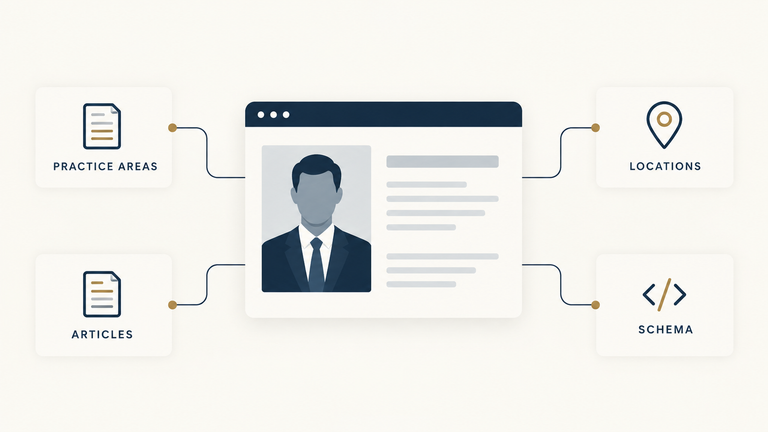
The clearest structural pattern was therefore not a specific law firm SEO template. Each ranking page worked as a connected hub rather than a standalone service page.
For your law firm, the practical takeaway is to make the ranking page part of a clear website structure. Connect the service to your attorneys, locations, and relevant internal pages.
Were the Ranking Pages Supported by the Rest of the Website?
Firm B’s crawl was capped, so its figures reflect the pages identified in our crawl rather than the entire website.
| Internal linking signal | Firm B | Firm C |
|---|---|---|
| Internal pages linking to ranking URL | 39 identified | 17 |
| Attorney pages linking in | 19 | Not applicable |
| News/content pages linking in | 16 | 15 content-area links |
| Main anchor text | Litigation | Home and Back to Home Page. |
| Ranking page linked to | 19 attorneys + 22 articles/news URLs | Service sections + deeper resources |
Firm B Was Built Into a Litigation Ecosystem
Nineteen were attorney profiles, and 16 were news or content pages. Every identified incoming link used “Litigation” as its anchor text.
The Litigation page also linked back to all 19 attorneys and surfaced related articles and news.
The pattern was clear:
Attorneys ↔ Litigation page ↔ related content
Interestingly, the main service copy contained no inline internal links. Most connections came through attorney modules, tabs, and related-content sections.
Firm C Sat at the Center of the Website
All 17 other HTML pages found in our crawl linked back to the homepage. Fifteen also included a content-area link.
Most anchor text was generic, such as “Home” or “Back to Home Page.” The homepage then linked visitors to deeper resources and used jump links to reach specific business law services on the same page.
What Was Cited When AI Recommended these Firms?
Across Firms A and B, firm-owned service pages were the most consistent citation source. That pattern appeared across AI Overviews, AI Mode, Perplexity, and Gemini.
For a deeper look at the pages and sources AI systems cited across the firms that appeared on all five platforms, see our analysis of AI visibility for law firms in 2026.
| AI tool | Firm A | Firm B |
|---|---|---|
| AI Overviews | 5 cited recommendations, all included Business Law page | 1, cited Litigation page |
| AI Mode | 7, all included Business Law page | 2, both cited Litigation page |
| Perplexity | 2, both cited Business Law page + Justia | 1, cited broader Business page |
| Gemini | 4, all cited Business Law page | 1, cited Litigation page |
Firm A’s Business Law Page Was Cited by AI Overviews, AI Mode, Perplexity, and Gemini
Firm A had 18 recommendations with citations. Every one included the same Business Law practice area page.
That matters because it was also the page we saw ranking in Google for Business Lawyer searches.
The page appeared as a source in:
- 5 AI Overviews recommendations
- 7 AI Mode recommendations
- 2 Perplexity recommendations
- 4 Gemini recommendations
Justia appeared six times as an additional source, mostly for Newark searches.
The third-party pattern also varied by AI tool. Perplexity cited Justia alongside the firm page in both of its cited recommendations. Gemini never used it.
Firm B’s Litigation Practice Area Page Was Cited by AI Overviews, AI Mode, and Gemini
AI Overviews, AI Mode, and Gemini all cited the firm’s Litigation page for Business Litigation recommendations.
That was also Firm B’s Google-ranking practice area page.
Perplexity behaved differently. For its broader Business Law recommendation, it cited Firm B’s broader Business & Commercial Services page instead.
So the cited page generally followed the scope of the query.
What Did Their Google Business Profiles Have in Common?
They did not.
What they did share was a strong review profile and a listing that gave potential clients clear evidence that the firm was active.
| GBP signal | Firm A | Firm B | Firm C |
|---|---|---|---|
| Primary category | Law Firm | Law Firm | Law Firm |
| Reviews | 464 | 453 | 161 |
| Rating | 4.9 | 4.7 | 5.0 |
| New reviews | Almost weekly | Almost daily | Almost weekly |
| Reviews describe services | Yes | Yes | Yes |
| Owner responses | Every review | Almost every review | Every review |
| Services listed | No | Yes | No |
| Posts | Sporadic | Frequent | Frequent |
| Products | None identified | None identified | Law firm packages |
| Website link | Homepage | Hamilton office page | Homepage |
You Do Not Need Hundreds of Reviews to Compete
What all three had was ongoing review activity.
New reviews appeared almost weekly for Firms A and C and almost daily for Firm B. The reviews were also specific. Clients described the legal service they received, and Firm B’s reviews often named the attorney who helped them.
For your law firm, that means review quality and recency deserve attention alongside total review count.
Responding to Reviews Was Consistent Across All Three Firms
That gives potential clients more context when they read the listing and may also reinforce the firm’s relevance around particular legal services.
We cannot call review responses a ranking factor from this study alone. But they were one of the few Google Business Profile habits shared across all three firms.
You Do Not Need to Use Every GBP Feature the Same Way
Firm C instead used Products to show law firm packages.
Firms B and C posted frequently. Firm A did not.
Firm B had no business description. Firm C explicitly mentioned business law, while Firm A’s description focused more heavily on employment law.
So if you are trying to optimize your Google Business Profile, do not assume every field has to be completed in exactly the same way.
A Broad Primary Category Did Not Prevent Visibility
That does not mean category selection is unimportant for local SEO. It means a narrow practice-area category was not something these three visible firms had in common.
Your GBP Does Not Have to Link to the Page Ranking Organically
None pointed directly to the practice area page we saw ranking in Google Search.
For a law firm owner, that matters because your organic search result and your Google Maps listing do not have to rely on the same landing page.
Different parts of your law firm website can support visibility in different search environments.
What This Means for Your Law Firm
Do not treat Google Business Profile optimization as a checklist where every field must be perfect before you can compete.
The clearest shared pattern in these three firms was simpler:
- New reviews kept coming in.
- The reviews described the legal work performed.
- The firms consistently responded.
- Ratings remained strong.
If you are deciding where to spend your local SEO effort, maintaining an active review profile is one of the clearest areas to examine. Our broader Google Maps ranking factors for law firms analysis found the same pattern across the 19 distinct firms that appeared in the Local Pack.
Other GBP tactics may still help, but our 2026 data does not show that services, posts, Products, or business descriptions were required across all three firms.
Did Technical Quality Support Their Rankings?
Firm A’s security system prevented Lighthouse from loading the ranking page, so we excluded its PageSpeed scores from the comparison.
| Technical signal | Firm A | Firm B | Firm C |
|---|---|---|---|
| Mobile Lighthouse | Not available | 63 | 71 |
| Desktop Lighthouse | Not available | 68 | 87 |
| Mobile Core Web Vitals | Not available | Did not pass | No field data available |
| Notable performance metric | Test blocked | CLS 0.32 in field data | 8.8s mobile lab LCP |
| Indexable | Yes | Yes | Yes |
| Self-canonical | Yes | Yes | Yes |
| Structured data | Service-specific | None detected | LegalService and other schema present |
Perfect PageSpeed Scores Were Not Shared Across the Ranking Pages
Firm C recorded a mobile Lighthouse score of 71, with an 8.8-second LCP during that particular lab test.
These results show that strong search visibility was possible even when the ranking pages did not receive near-perfect performance scores.
For your law firm, PageSpeed still matters for user experience. But our analysis does not suggest you need a perfect Lighthouse score before a page can compete in search.
The Firms Used Structured Data Very Differently
Firm B’s ranking Litigation page had no structured data detected in our test.
Firm C used LegalService and Organization schema, along with location information. Its homepage also included Article and Person markup.
The implementations were quite different, so structured data was not a technical feature shared by all three ranking pages. See our guide on schema markup for law firms for more information on how structured data for law firms works and whether it improves SEO and AI visibility.
So, What Are the Law Firm SEO Ranking Factors in 2026?
For your law firm, six areas stand out.
1. Make Your Practice Area Page Closely Match the Legal Service Being Searched
Most of the ranking pages and pages were practice area pages, and each ranking page made the legal service behind the search clear. That did not require an exact-match keyword in every heading. Firm C ranked for “Business Lawyer” even though its H1 was the firm name.
For law firms, this is one reason dedicated practice area pages are so important. If you want to rank for a particular legal service, that service should usually have a page that clearly explains what the firm handles, who it helps, and the legal issues involved. A few sentences buried on a broad services page may not give prospective clients or search engines enough information to understand that the firm handles that specific type of matter.
If you want to improve the pages you already have, see our guide to optimizing law firm practice area pages. If you would rather have us research, write, and optimize them for you, see our practice area page writing service.
2. Support Important Practice Pages From the Rest of Your Website
The ranking pages were connected to relevant attorneys, supporting content, or other parts of the website. Firm B showed this especially clearly, with attorney profiles and litigation content linking into the Litigation page while that page linked back out to them.
For your law firm, build those connections in both directions.
3. Show Who Handles the Legal Work
If a prospective client lands on one of your practice area pages, they should not have to search the rest of your website to find out who handles that work.
Make that relationship clear on the page through dedicated attorney modules or contextual mentions within the copy, with internal links to each lawyer’s dedicated attorney bio page.
4. Make Your Geographic Relevance Clear
Firms A and B even ranked the same practice area page in multiple markets. What mattered more was that the firm had a clear connection to the places it serves through its website and local presence.
For your law firm, focus on making that geographic relationship easy to understand rather than forcing location keywords into every URL or heading.
5. Give Google a Clean Technical Foundation
Beyond that, their technical setups varied considerably. Perfect PageSpeed scores were not shared, and sophisticated schema was not required across all three firms.
Your priority should be making sure Google can reliably access and understand your important pages. Improve speed and structured data where useful, but do not wait for a technically perfect website before strengthening the pages that matter to prospective clients.
6. Keep Your Google Business Profile Review Activity Active
All three firms had strong ratings, continued receiving new reviews, and had clients describing the legal services they received. All three also responded consistently.
Our data does not point to a magic review count. Firm C appeared with 161 reviews while Firms A and B each had more than 450.
For your law firm, the more useful goal is to build an ongoing review process rather than chase a particular number.
Taken together, the pattern was less about checking every SEO box and more about making your firm easy to understand. Your important practice area pages should clearly explain the service, connect it to the attorneys who provide it, and fit naturally into the rest of your website. Google should also be able to place your firm in the right market and access those pages without friction.
See How Your Law Firm Website Compares
TypeTopia Agency will review your website using the same areas we examined in this analysis, including the relevance of your practice pages, internal linking, attorney connections, local visibility, and technical foundation.
You will come away knowing where your website is already strong, where visibility may be breaking down, and what you should prioritize next.
Request Your Law Firm Marketing Audit or email is directly at inquiries@typetopiaagency.com.
You can also see how this kind of work plays out over time in our law firm SEO case study, which follows a three-year strategy that increased annual organic sessions by 401%.
At TypeTopia Agency we are dedicated to helping law firms, solo attorneys, and boutique practices attract qualified leads through law firm marketing services.
Frequently Asked Questions
Can a Smaller Law Firm Compete With Larger Firms in Google Search?
Firm C was considerably smaller than the other two firms and had fewer reviews, yet it still appeared in organic search, the Local Pack, and ChatGPT.
For your law firm, the goal is not to compete for every possible legal query. A focused SEO campaign can concentrate on the services you most want to grow and the searches most likely to bring the right prospective clients to your firm.
Which Pages Should My Law Firm Prioritize for SEO?
Then support those pages with the rest of your website. Relevant attorney bios should connect the service to the people handling the work. Location pages can reinforce where your firm operates. Blog articles can answer the questions prospective clients ask before they are ready to hire you, while firm news and press release pages can add further context around your attorneys and practice areas.
For your law firm, the goal is not to optimize every page equally. Build the strongest support around the practice area pages that matter most to the growth of your firm.
Should I Create More Law Firm Content or Improve the Pages I Already Have?
If you already have articles bringing visitors to your site but your main practice area pages are thin or poorly connected, publishing another article may not be the best next step.
Review the page that should attract the client first. Its on-page SEO should make the service clear, show who handles the work, and connect naturally to relevant pages elsewhere on your website.
Create additional content when it strengthens that structure or answers a real question potential clients are searching for. Publishing simply to add more keywords is not how effective SEO for law firms should work.
Does My Law Firm Need a Separate Page for Every City We Serve?
In our study, Firms A and B ranked the same practice area page in multiple New Jersey markets. Neither needed a separate service page for every city to achieve local visibility.
A location page can still be useful when you have a genuine presence in that market or enough local legal information to justify the page. But creating near-identical pages and changing only the city name can quickly become keyword stuffing.
For local SEO for law firms, the better question is whether Google can clearly connect your firm to the market you serve.
How Do I Know What Is Stopping My Law Firm Website From Ranking?
Then compare that page with the law firms already appearing in the Google search results. Look at whether your page satisfies the same search intent and whether the rest of your website supports it.
You should also confirm that Google can crawl and index the page. Google Search Console can help identify indexing problems and show whether the page is already receiving impressions.
For local rankings, review your Google Business Profile as well. Make sure the listing is accurate, verify your Google Business Profile if needed, and look at how your review activity compares with other local businesses competing for the same searches.
There usually is not one SEO ranking factor responsible for poor visibility. A useful law firm SEO audit identifies where the gap actually exists.
How Long Should Law Firm SEO Take to Produce Results?
Improving a page that already appears near the first page of organic search is very different from trying to rank higher for a new practice area on a website with little existing visibility.
Your starting position matters, as does the competition in the Google search results.
Instead of judging whether SEO works after an arbitrary number of months, establish a baseline and track whether the pages that matter are gaining visibility for the searches you want to own.
If you want to see how that can play out in practice, our law firm SEO case study follows a multi-year SEO strategy for a business law firm.
How Should I Measure Whether Law Firm SEO Is Actually Working?
The more important question is whether your firm is becoming easier to find for the legal matters you want to handle.
Use Google Search Console to see which queries are producing impressions and clicks. Then look at whether the pages attracting that traffic are generating calls, consultation requests, or other ways for prospective clients to contact your firm.
If you are investing in local SEO, track Local Pack visibility and Google Business Profile activity as well.
Successful SEO for lawyers should help your law firm grow the areas of the practice you actually want to expand, not simply produce a larger traffic number.
Do I Need to Redesign My Law Firm Website Before Investing in SEO?
If Google can crawl and index your website and potential clients can use it comfortably, you may be able to make significant SEO improvements without rebuilding the entire site.
Our study also found that perfect Core Web Vitals scores were not shared across the ranking firms. That does not make site performance unimportant, but it does mean you should not assume a complete redesign is required before SEO can begin.
A redesign becomes more relevant when the existing website prevents you from improving important practice pages or creates serious usability problems.
For many law firms in 2026, improving the website you already have is the more practical place to start.
Found this useful? See more from TypeTopia Agency in Google.
Add TypeTopia Agency as a preferred source to tell Google you’d like to see more of our law firm marketing research and guides.