Did You Know That Your Law Firm Website Is Only One Point of Discovery?
Want to see more TypeTopia Agency research in Google?
Add TypeTopia Agency as a preferred source to tell Google you’d like to see more of our law firm marketing research and guides.
If your law firm marketing strategy begins and ends with publishing content, getting it indexed, and trying to rank it, you may be leaving other opportunities to be found on the table.
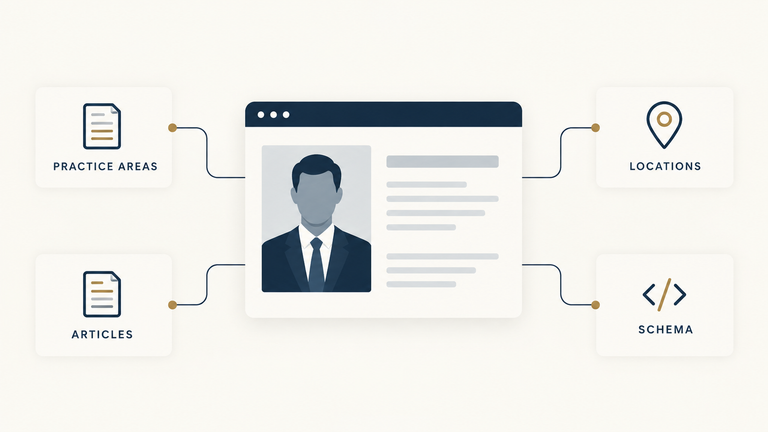
Your website is still the foundation of your law firm’s online presence. It is where you control your practice area pages, attorney bios, location pages, articles, and the information a potential client needs before deciding whether to contact you.
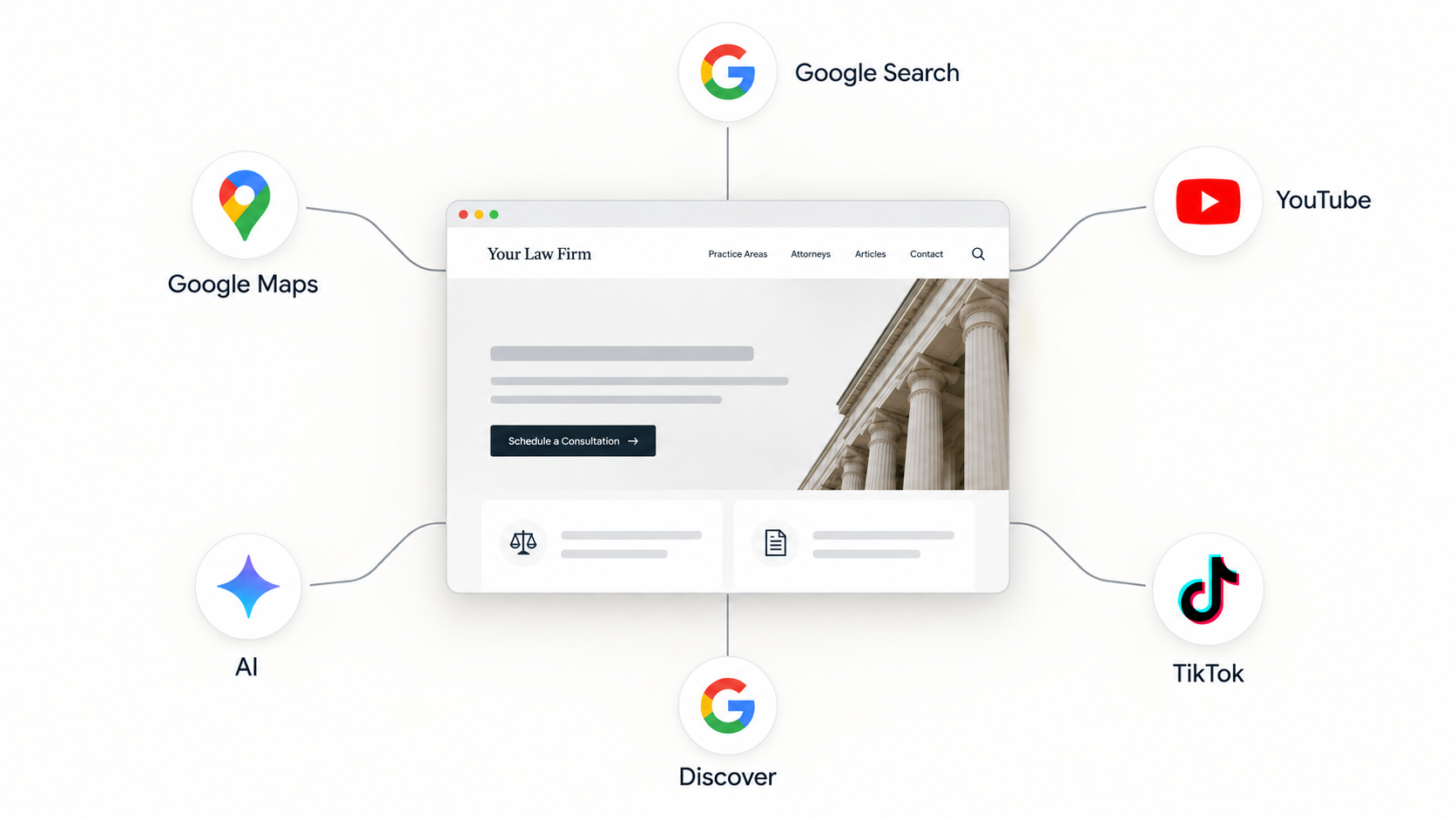
But a prospective client does not have to reach your firm through your website first.
They may discover you through:
- local results in Google Search or Maps;
- a YouTube video, either on YouTube itself or surfaced in Google;
- a TikTok, Instagram, or X post that appears in search results;
- your content being cited in an AI tool;
- a recommendation in Google Discover.
That is the opportunity this article explores. We look at the evidence showing how Google is connecting websites with content published elsewhere, then work through how you can build a stronger online presence without trying to be on every platform.
Quick Answer: How to Build a Law Firm Online Presence Beyond Your Website
- Get the website right first. Make sure your homepage explains who you help, your practice area pages cover the matters you actually want, your attorney bios establish who does the work, and your location pages accurately reflect where you practice.
- Build your local search presence alongside it. Claim and optimize your Google Business Profile, keep your business information accurate, and build a consistent process for requesting reviews from satisfied clients.
- Create content around real client questions, not keywords alone. Prioritize non-commodity topics where your attorneys can add judgment, experience, useful distinctions, or information that is difficult to get from a generic legal article.
- Map that content to the client journey. Some content should help someone understand the problem. Other content should help them decide what to do. Your practice pages, attorney bios, reviews, and intake information should then help qualified prospects decide whether your firm is the right fit.
- Use strong articles as the source material for distribution. Turn selected evergreen articles and important legal developments into YouTube videos. Do not simply read the article on camera. Pull out the parts that benefit from an attorney explaining them.
- Optimize those videos for discovery. Build the title around the legal question, make the subject clear in the thumbnail, write a useful description, add chapters when appropriate, and link back to the relevant page on your website.
- Extract useful moments for YouTube Shorts and TikTok. Each short video should answer one identifiable question on its own rather than functioning as a random excerpt from the longer video.
- Connect and measure your properties. Use Search Console to monitor supported YouTube and social platform content appearing in Google Search. If your firm becomes eligible for a Google Search Profile, claim it and connect the properties you want Google and users to recognize as belonging to the same publisher.
Why We Think Google Search Is Moving in This Direction
| Date | What Google changed | Why it matters to your law firm |
| Aug. 12, 2025 | Google launched Preferred Sources in the U.S. and India. | People could begin telling Google which websites they wanted to see more often in Top Stories. |
| Dec. 16, 2025 | Preferred Sources expanded globally for English-language users. | Google reported that people who selected a Preferred Source clicked through to that website about twice as often on average. |
| Apr. 30, 2026 | Preferred Sources began rolling out globally across all supported languages. | What started as a limited Search feature was becoming a much broader way for people to influence which sources Google shows them more often. |
| May 27, 2026 | Google brought Preferred Sources into AI Overviews and AI Mode. | A source someone already prefers can now be identified inside Google’s AI search experiences as well as Top Stories. |
| June 4, 2026 | Google launched Search Profiles for publishers and creators. | A Search Profile can bring a publisher’s articles, videos, social posts, and other online properties together in one Google-based profile. At launch, eligibility required at least 100,000 followers on YouTube, Instagram, or X, or 300,000 on TikTok. |
| July 7–29, 2026 | Search Console introduced platform properties for YouTube, Instagram, TikTok, and X, then made them globally available. | Google described this as helping publishers understand audiences reached through channels “beyond websites.” |
| Aug. 20, 2026 | Google released an embeddable Preferred Sources button for publishers. | Webmasters could place the button on their own websites and give readers a direct way to make the site a Preferred Source in Google. |
| Sept. 16, 2026 | Google lowered Search Profile eligibility to 10,000 followers on YouTube, Instagram, X, or TikTok. | Search Profiles became accessible to a much broader group of U.S. publishers and creators. |
| Sept. 16, 2026 | Google documented a Search Profile badge that publishers can add to their websites. | Your website can send an existing reader to your Search Profile, where that person can follow your firm and potentially encounter more of its content through Google later. Google also recommends profile links in places such as newsletters and article bylines. |
Look at those changes together and the direction becomes easier to see.
Google is still indexing and ranking webpages. Your law firm still needs a website that clearly explains its practice areas, attorneys, locations, and legal services. Good law firm SEO has not suddenly become less relevant.
What has changed is the number of ways content outside your website can participate in organic discovery.
- Search Console can measure off-site content. You can see which Google searches are leading people to your YouTube videos or posts on supported social platforms.
- Search Profiles can bring your properties together. Google can connect content from your website, YouTube channel, and supported social accounts around one publisher profile.
- Preferred Sources can turn readers into returning searchers. Someone who values your website can tell Google they want to see more from that source in supported Search experiences.
- Google Discover creates another path to your content. Articles, videos, and social content from publishers and creators can surface based on a person’s interests, even when they are not actively searching for that topic.
Google described the change particularly clearly when it rolled out platform properties globally in July 2026: publishers now reach audiences through a “diverse range of channels beyond websites.”
That does not mean a TikTok following will push a practice area page higher in Google, or that reaching 10,000 YouTube subscribers is a new SEO ranking factor. Google has not said either of those things.
It means your organic visibility no longer has to depend entirely on whether someone finds and clicks a page on your law firm’s website.
The same legal knowledge can live on your website, become a video someone finds through YouTube or Google, and reach another audience through a social account. If you build an audience around that work, Google is increasingly providing ways for those people to follow your firm, prefer its website, and encounter its content again.
How to Build a Stronger Law Firm Online Presence
Optimize Your Law Firm Website Before Expanding Elsewhere
Start with your law firm’s website. It is the foundation of your online presence and where the other discovery sources you build should eventually point a potential client.
Make sure the site loads quickly and works well on mobile devices. A slow or difficult-to-use website can weaken the experience for someone who reaches your firm through Search, Maps, YouTube, or another source. Tools such as GTmetrix and PageSpeed Insights can help you identify performance issues.
Next, build and optimize the core pages that explain who your firm is, the legal services you provide, and where you practice:
- Homepage: Your law firm homepage is your online lobby. It should quickly explain who you help and what you do. See our law firm homepage guide for more on content, on-page SEO, and optimization.
- Attorney bios: These pages introduce the lawyers providing your legal services. They should explain each attorney’s practice areas and connect to relevant practice pages and content. Read our attorney bio page guide for more details.
- Practice area pages: These pages explain the specific services your firm provides. They deserve particular attention because practice and service pages were the most commonly cited firm-owned URLs in our 2026 New Jersey law firm visibility analysis. See our practice area page guide for how to optimize them for people, search engines, and AI tools.
- Location pages: These pages explain where your firm practices and, where relevant, where you have offices. Avoid simply duplicating the same page for different cities. See our law firm location page guide for more.
Building and optimizing these pages gives you the foundation to build on before you start expanding your law firm’s online presence through content, YouTube, social media, and other discovery sources.
If you would like TypeTopia Agency to build or optimize your law firm website, write your content, or improve your online visibility, contact us at inquiries@typetopiaagency.com.
Build and Optimize Your Local Search Presence
In our Map Pack ranking analysis, we looked at the law firms appearing in the top three local results for business law and business litigation searches across four New Jersey locations. While there are many ways to optimize a Google Business Profile, reviews produced the clearest pattern in our data.
Fifteen of the 19 firms we observed were receiving new reviews at least monthly.
Google also confirms that review count and positive ratings can help local rankings. Build review requests into your process for closing matters. Your Google Business Profile gives you a direct review link that you can share with satisfied clients.
You can also publish Google Business Profile posts to share firm news, legal updates, or useful content. We did not find GBP posting to be nearly as consistent among the firms ranking in the Map Pack, so I would prioritize reviews first if your time is limited. Google now provides performance data that can help you see how people are finding and interacting with your Business Profile.
Create Law Firm Content Around the Legal Questions Your Clients Search For
Once the foundation of your law firm’s online presence is in place, you can start thinking about your content strategy. A useful place to begin is with the difference between commodity and non-commodity content.
- Commodity content: Google describes this as content that “is often based on common knowledge, which could originate from anyone, and typically adds little unique insight for readers.”
- Non-commodity content: This is content that adds something specific, such as first-hand experience, proprietary data, or expert judgment that is not common knowledge.
When deciding what to publish, start by putting yourself in the shoes of the clients you want to attract. Think about who they are, what is on their mind, the problems they are trying to solve, and what they would need to understand before contacting your firm.
Then use your legal knowledge to answer those questions.
That does not mean an attorney has to write every article. You can work with an experienced legal content writer, then have the attorney review the content and add the details or judgment that make it specific to the firm.
The same principle applies to SEO.
Do not start with a keyword and build the article around the keyword alone. Start with the potential client and the information that would genuinely help them, then use SEO to make that content easier for search engines, AI tools, and the right audience to discover.
SEO should support useful content, not dictate why the content exists.
Map Your Law Firm Content to Search Intent and Client Stage
Top-of-Funnel Content
Top-of-funnel content is for someone who is still trying to understand a legal problem or situation.
That could include questions such as:
- What happens if my business partner wants to leave and our operating agreement says nothing about a buyout?
- My business just lost in court and cannot afford the judgment. What happens next?
- I discovered hidden assets after my divorce. What can I do?
- How can I transfer my business to my child or spouse?
At this stage, your job is to answer the legal question well enough for the person to understand what may be happening and what issues they should be thinking about. Informational articles, legal updates, YouTube videos, and short-form content can all work here.
Middle-of-Funnel Content
At the middle of the funnel, the prospective client has a better understanding of the legal problem. Now they are trying to decide what to do about it.
Your content should help them work through the decisions, tradeoffs, and consequences that come next.
For example:
- My prosecutor offered probation in exchange for a guilty plea. What should I consider before accepting it?
- My spouse wants to keep the house. Should I take other assets in exchange for my equity or insist on a sale?
- I am bringing a new owner into my LLC. Should they receive voting rights immediately or earn them over time?
- My business partner locked me out of the company. Should I seek an injunction or negotiate a buyout?
This is where the attorney’s judgment becomes especially useful. The prospective client does not need another definition of an injunction, plea agreement, or operating agreement. They need help understanding what facts could change the decision in front of them.
Bottom-of-Funnel Content
At the bottom of the funnel, your legal marketing strategy has a different job: reduce the uncertainty standing between a qualified prospect and contacting your firm.
The questions are now about whether your firm is the right fit.
| What the prospective client wants to know | Content that should answer it |
|---|---|
| Does this firm actually handle my type of matter? | Practice area page |
| Does this attorney know this particular issue? | Attorney bio linked to the relevant practice area and supporting content |
| Does the firm represent clients like me? | Who-we-help page, practice area content, relevant case studies or case results where permitted |
| Does the firm practice where my matter is located? | Location page |
| What do other clients say about working with the firm? | Google Business Profile reviews and testimonials where permitted |
| What happens if I contact the firm? | Consultation, intake, or contact page that explains what the prospective client should expect |
Build a Content Distribution Strategy Around What You Already Publish
Start With Legal Articles
Articles give you space to research and create an asset on a website you control. Your law firm articles should be:
- Non-commodity: Add the attorney’s experience, judgment, data, or other information that makes the article more useful than a generic explanation of the law.
- Optimized for on-page SEO: Use the language your target audience searches for naturally in the title, headings, copy, and other relevant page elements.
- Technically optimized: Make sure search engines can crawl and index the page. Add appropriate structured data where it accurately describes the content.
- Connected to the rest of your website: Link the article to relevant practice area pages, attorney bios, location pages, and other useful content.
- Accessible to search engines and AI tools: Do not hide the substance of the article behind formats or technical barriers that make the content difficult to retrieve.
See our law firm article writing guide for a deeper look at how to research, write, and optimize legal articles for prospective clients, search engines, and AI tools.
Turn the Best Parts of Your Article Into a YouTube Video
Once you have recorded the video, the next step is making it easier for prospective clients looking for that information to find it. That is where YouTube SEO comes in. Keep a few things in mind:
- Start with the legal question at the heart of the video: Let that question guide the title, description, and language you use when discussing the issue.
- Write a clear title and create a useful thumbnail: A prospective client should be able to understand what the video is about before deciding whether to watch it.
- Optimize the description and chapters: Use the description to explain what the video covers and link back to the relevant article or page on your law firm’s website. For longer videos, add chapters so viewers can move to the part of the discussion they need.
- Add your firm’s location: Tag the video with the same real-world location you use on your Google Business Profile. This keeps the geographic information around your firm consistent and gives YouTube additional location context for the video.
- Monitor performance: Use YouTube Analytics to see how viewers are finding the video, whether they are clicking it, and how long they continue watching.
For more information, see our guide to YouTube SEO for law firms.
Optimize Your Law Firm Videos for YouTube Search
Next, consider adding YouTube to your law firm’s content distribution strategy.
There is already a large audience there. Pew Research Center found that 84% of U.S. adults use YouTube. More importantly for a law firm, people are already using video to research legal problems. In FindLaw’s 2024 U.S. Consumer Legal Needs Survey, one in six respondents who searched for legal information online looked for videos. Among those people, 79% used YouTube.
There is also room for more law firms to build a presence there. In the ABA’s 2024 Legal Technology Survey, only 10% of respondents said their firms maintained a YouTube presence.
That gives you another place to put the legal knowledge you are already producing in front of prospective clients.
But you do not need to turn every article on your website into a video. Be selective about the topics that justify the additional production time.
Good candidates include:
- Evergreen client questions: Legal problems your attorneys hear repeatedly and that will still be useful to prospective clients a year from now.
- Important legal developments: New laws, court decisions, or rule changes that create questions for the people your firm serves.
- Firm and service content: Videos that help someone understand who your attorneys are, the matters your firm handles, or where you practice.
- Issues that benefit from an attorney explaining the nuance: Topics where the answer changes depending on the facts and the attorney can explain what a prospective client should be thinking about.
Once you choose an article, do not simply read it into a camera. Pull out the parts that are most useful to someone watching the subject explained, then rewrite them for speech. The video may cover fewer points than the article and spend more time on the distinctions that benefit from an attorney talking them through.
See our law firm YouTube script writing guide for more on choosing a topic and turning your written content into a useful video.
Turn Your YouTube Videos Into Short-Form Content
Once you have recorded a longer YouTube video, you already have material that can be adapted for YouTube Shorts and TikTok. You do not need to research a new legal topic every time you want to publish a short-form video.
Go back through the longer video and look for individual explanations that can stand on their own. The goal is not to cut the video into arbitrary 30-second pieces. Each clip should answer one identifiable question without requiring someone to have watched the full video first.
For example, a longer video about a dispute between 50/50 business owners could give you separate short-form videos answering questions such as:
- Can my business partner lock me out of our company?
- Can one 50/50 owner force the other owner to sell?
- What happens if our operating agreement does not address deadlocks?
- Can I seek an injunction after my business partner locks me out?
Each clip gives someone another way to discover your law firm around a problem they are actually trying to understand.
Publish Useful Clips as YouTube Shorts
Search also matters. YouTube says Shorts appearing in Search are ranked partly according to how well their metadata matches the search and whether viewers choose to watch them.
Apply the same audience-first approach you used for the original article. If the clip answers whether a business partner can lock another owner out of an LLC, make that issue clear in the title. Establish the question quickly in the video itself.
See our guide to YouTube Shorts for law firms for a deeper look at creating and optimizing Shorts.
Adapt the Same Ideas for TikTok
TikTok also says the match between a piece of content and someone’s search query can influence search results. User behavior on the platform is another factor.
That makes specific legal questions useful starting points for TikTok content too.
TikTok’s Creator Search Insights can also show creators topics people are searching for and identify subjects with a content gap, where searches exist but relatively few videos address the topic.
You do not necessarily need to record a separate video for TikTok. An appropriate clip from your longer YouTube video can be adapted for the platform. Make the legal question clear early, add readable on-screen text, and write a caption that accurately describes the problem being discussed.
Avoid treating every short video as a teaser that withholds the answer. Give the viewer something useful in the clip itself. If the issue requires more context, you can then direct them to the longer video or the full article on your law firm’s website.
See our TikTok SEO guide for law firms for more on finding search topics and optimizing individual videos.
Build Your Law Firm’s Online Presence One Layer at a Time
Start with the foundation you already have. Strengthen the pages that explain your firm and services, then build content around the legal questions your clients actually ask. From there, expand into YouTube, short-form video, local search, or other channels when they make sense for your audience.
See how we built the strategy in our law firm SEO case study.
If you want help building that system, TypeTopia Agency works with law firms on website strategy, high quality legal content, SEO strategies, and other aspects of your digital presence. Contact us at inquiries@typetopiaagency.com.
Frequently Asked Questions About Building a Law Firm Online Presence
Found this useful? See more from TypeTopia Agency in Google.
Add TypeTopia Agency as a preferred source to tell Google you’d like to see more of our law firm marketing research and guides.