The Law Firm Blog Is Not Dead. The Way It Gets Found Has Changed.
Law firm blogs are still relevant in 2026 because they can still help generate qualified leads for your firm. What has changed is how prospective clients find the information you publish.
Since ChatGPT went mainstream, people who once searched Google for legal information and clicked through to articles on law firm websites like yours can now get an answer from an AI Overview or a tool like ChatGPT or Gemini without ever visiting a law firm’s website.
So, if you have been publishing articles for years, you may be wondering whether your law firm blog is even relevant anymore.
But think about why you were publishing those articles in the first place. Was the ultimate goal traffic, or was it qualified leads?
It was the latter.
Your prospective clients still have legal questions, and they still need to find the right attorney when those questions turn into problems they need help solving.
So yes, you should still be writing articles. But you need to be much more intentional about what you publish and why, including when updating existing content instead.
Let’s look at what that means for your law firm.
Key Insights for Law Firm Owners
- Law firm blogs still have a role in 2026, but publishing articles just to keep a blog active is not enough.
Each article should support a specific type of matter your firm wants to attract. - Start with the business opportunity, not the keyword.
Decide which services you want to grow, the types of clients and matters you want, and the locations you want those matters to come from before choosing topics. - Build content around the questions prospective clients ask throughout a legal matter.
This creates a connected body of useful content instead of a collection of unrelated keyword-driven articles. - Optimize articles for discovery beyond traditional Google results.
Your content may also surface through AI Overviews, AI Mode, ChatGPT, Gemini, Perplexity, Bing, and other discovery channels. - Publishing is only part of the job.
Strong internal linking, clear page structure, titles, headings, schema, links to attorney profiles, and other technical and on-page elements help search engines and AI systems understand how each article relates to your firm and its services.
How Law Firm Blogs Get Found in 2026
Yes, law firms still need a blog in 2026. If you are questioning whether it is still worth paying for new articles, remember what you ultimately want them to do: help generate business for your firm.
Articles can still do that, but the path from publishing an article to getting discovered has changed. Your prospective client is no longer limited to typing a legal question into Google and choosing one of the traditional search results. They may get an AI-generated answer directly in Google, ask ChatGPT, or use another search and AI tool.
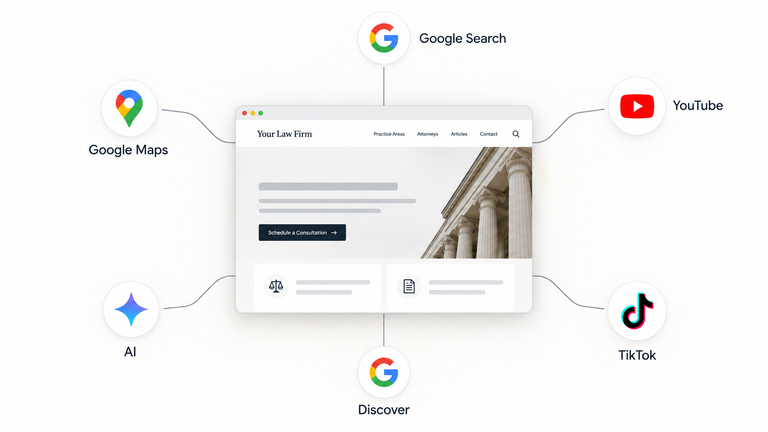
That gives a useful law firm article several paths to discovery.
Traditional Google Search
Google Search is still very much alive. In the first quarter of 2026, Google reported that search queries had reached an all-time high. Google also said its AI features were contributing to that growth, rather than replacing Search.
That means the traditional search results still matter. If someone searches for a legal question your article answers, that page gives your firm another opportunity to appear in the SERP and put your name in front of a prospective client.
Google AI Answers
AI Overviews and AI Mode are also creating another path to discovery for your law firm articles. Both are taking up more space in Google Search, and Google now lets people move from an AI Overview into AI Mode to continue asking questions.
The important thing for your firm is that these answers still rely on information from the web. When someone asks about a legal issue you handle, Google can search for relevant pages and may link to your article as a supporting source within the AI answer.
This becomes especially useful when someone asks a more detailed question. AI Mode can search across different parts of that question, which means an article addressing one specific issue may become relevant even if the prospective client never searched the exact keyword you originally targeted.
Bing and Microsoft Copilot
Bing gives your articles another search ecosystem to appear in. As of September 2026, Bing accounted for about 9.9% of U.S. search-engine usage, making it the second-largest traditional search engine behind Google.
It also sits behind Microsoft Copilot’s web search. When web search is enabled, Microsoft says Copilot can generate search queries and send them to Bing to retrieve relevant information.
So an article indexed by Bing has two potential routes to discovery. Someone may find it in a normal Bing search, or the page may help ground an answer someone receives through Copilot.
ChatGPT, Perplexity and Other AI tools
Other AI tools can also find and cite your articles.
ChatGPT uses OAI-SearchBot to discover pages that can appear in ChatGPT Search. OpenAI says any public website can be eligible to appear, provided its search crawler is allowed to access the content.
Perplexity has built its own large-scale search index and crawling infrastructure. Its search system indexes web pages and retrieves relevant sections when answering questions.
How Do You Turn a Law Firm Blog Into a Discovery Tool?
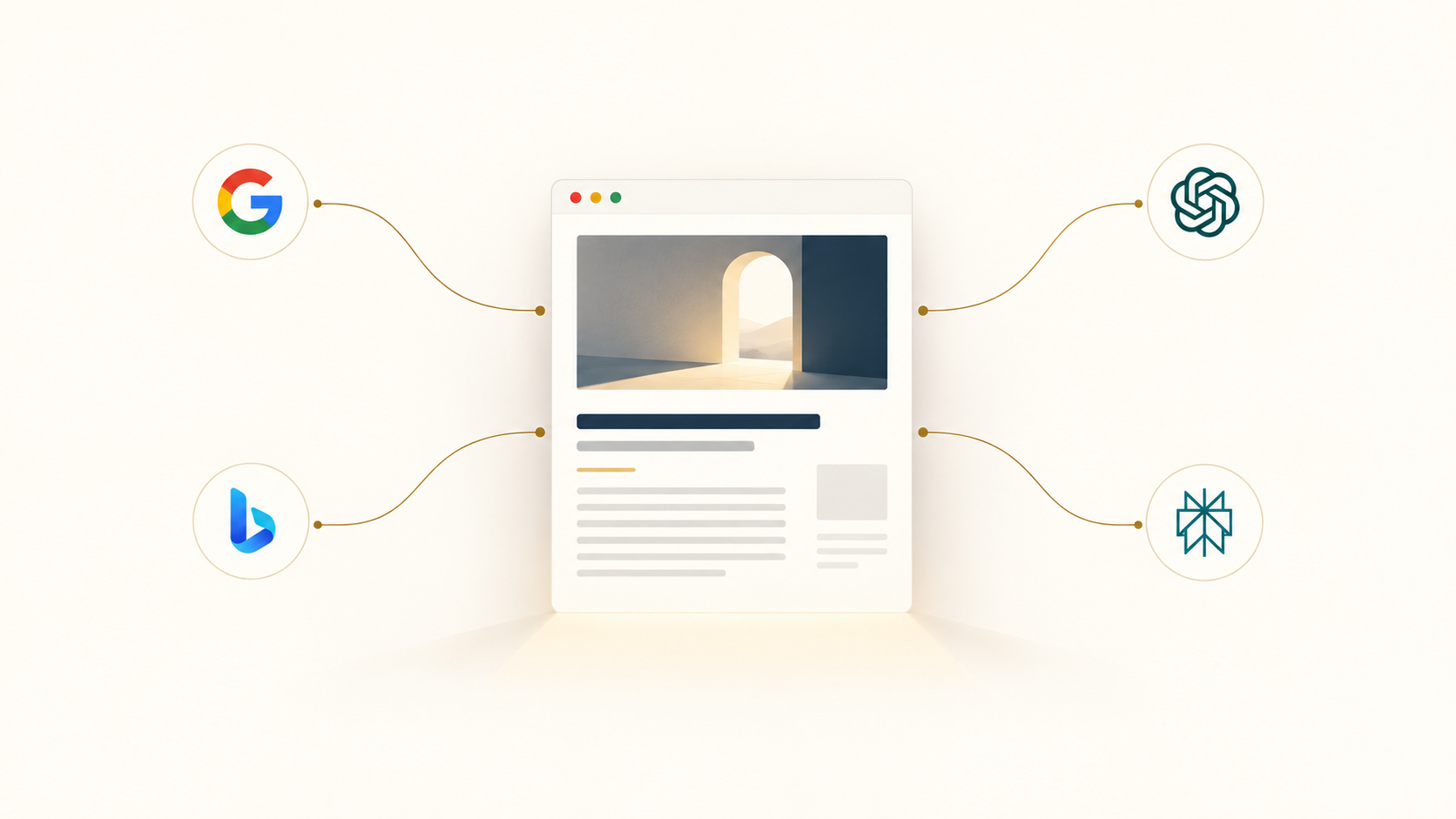
If your law firm articles can surface in Google, Google’s AI answers, Bing, Copilot, ChatGPT, Perplexity, and other discovery tools, the next question is how you or your content writer should approach what gets published.
Start With the Matters You Want to Attract
This is something your content writer needs your input to decide. You know which services your firm wants to grow and which types of matters are a good fit for your attorneys.
Start by thinking about:
- What services does your firm want to grow?
- What types of matters do you want more of?
- Where do you want those matters to come from?
- Who are the clients you want those matters to reach?
- What questions are those prospective clients asking when they speak with your intake team or an attorney?
For example, if business litigation is a priority, focus on the disputes your firm wants to handle and the questions those potential clients ask. Those conversations can give you much better insight into what your law firm blog should cover than starting with a list of keywords alone.
This is also why there should be a clear line of communication between your marketing team and the people handling intake and client matters. Your content writer needs to know what prospective clients are asking about, because those questions can help you identify legal topics that deserve clear, practical guidance.
Keyword Research: Map Those Matters to How Prospective Clients Search
Once you know which matters you want your law firm to attract, the next step is figuring out how prospective clients look for information about those problems online.
That includes traditional keyword research. You want to understand the language people use when they search Google, because it may be very different from the language your attorneys use internally.
For example, your firm may think about a matter as a shareholder oppression dispute. A prospective client may search for:
- Business partner forcing me out
- Minority shareholder rights New Jersey
- Partner won’t let me see company records
- Can my business partner remove me from the company
Those searches are describing the same general type of problem from the client’s point of view.
Do not limit your research to the most popular keywords. Some of the more specific, long-tail searches may have much lower search volume, but that does not make them less relevant to your firm. If a query closely reflects the type of problem your attorneys handle and the matters you want to attract, it may be worth covering even if relatively few people search for it.
Don’t Forget About Prompt Research
Keyword research can help you identify patterns, but in 2026 you should go one step further and think about how the same person might describe the problem to an artificial intelligence (AI) tool.
Someone who searches Google for minority shareholder rights New Jersey might ask ChatGPT, Gemini, or AI Mode:
I own 30% of a New Jersey company and my business partner has stopped giving me access to the company’s financial records. What rights do I have?
The legal issue has not changed. What has changed is how much context the prospective client is giving the tool.
That means your research should help you understand questions such as:
- What language do prospective clients use to describe the problem?
- What questions appear around the topic in Google Search?
- What longer and more specific searches are people using?
- How would someone explain the same situation conversationally to ChatGPT or another AI tool?
- What facts are likely to change the answer, such as jurisdiction, timing, ownership percentage, or what has already happened?
There is also an important difference between traditional keyword research and AI prompt research. Search volume tools can give you an estimate of how often certain Google queries are used. There is not yet an equally reliable volume metric for every prompt people enter into ChatGPT, Gemini, or other AI tools.
So do not treat prompt research as keyword research with a different tool. Use it to understand the context people are likely to include, the follow-up questions they may ask, and the situations behind the search.
Build Article Topics Around the Client Journey
Try not to jump randomly between subjects because individual keywords look attractive. Pick one type of matter and follow what is likely to happen from the point the problem first appears through the later decisions the client may have to make.
Map the legal journey, not a generic awareness, consideration, and conversion funnel. As the facts change, the questions your prospective client asks will change too.
Take a will contest as an example.
Someone may first become concerned because a parent changed a will shortly before death. At that stage, they might be asking:
- Can I challenge a will that was changed shortly before someone died?
- What if I think my sibling pressured my parent into changing the will?
- Does dementia make a will invalid?
- What if someone else was present when the new will was signed?
If probate has already started, the questions become different:
- Can I stop the estate from distributing assets while I challenge the will?
- What if the executor refuses to give me estate records?
- Can an executor sell property while a will contest is pending?
- What happens if I discover that assets were transferred before my parent died?
Later, the dispute may become much more focused on evidence:
- Can medical records be used to challenge someone’s testamentary capacity?
- How do you prove undue influence if nobody witnessed it?
- Can text messages between family members be used in a will contest?
- What happens if the attorney who drafted the will becomes a witness?
By following the matter this way, you start finding article opportunities that reflect real developments in a client’s case rather than another list of broad probate keywords.
The same approach works in employment law, family law, and other practice areas.
An employment lawyer representing executives might follow a matter from the moment a client is asked to sign a new employment agreement, through a termination or severance negotiation, and later into a dispute over a restrictive covenant.
A family lawyer could follow the questions that arise when a divorce involves a privately owned business, concerns about hidden assets, temporary support or disagreements over how property should be valued.
The point is to ask what actually happens during the type of matter your firm wants. Each development can change what the client needs to know.
You also do not need a separate article for every question you uncover. Some questions belong together on one page. Others may already be covered well on your website, while some may be better suited to a practice area page.
The client journey gives you a map of the questions surrounding a matter. Your job is then to decide which gaps are important enough to deserve their own article.
Make Sure Your Articles Can Be Discovered
You need to make sure Google and the other discovery tools can access and understand the articles you create.
This is where technical and on-page SEO come in. You do not need to become a developer, but there are some basics your marketing or website team should be checking every time an article is published.
Start with whether the page can actually be discovered and indexed:
- Make sure the article is not accidentally set to noindex.
- Check that your robots.txt file is not blocking search crawlers from accessing it.
- Include new articles in your XML sitemap.
- Use the correct canonical URL so search engines know which version of the page you want indexed.
- Make sure the article loads properly on mobile and is accessible without requiring a login.
You should also think beyond Google. If you want your articles to be eligible to appear as sources in ChatGPT Search, OpenAI recommends allowing OAI-SearchBot to access your website. OpenAI treats this separately from GPTBot, which means you can allow your pages to appear in ChatGPT Search without necessarily allowing them to be used for model training.
For Bing, you can also use IndexNow to notify participating search engines when you publish or update an article.
Optimize Your Articles With On-Page SEO
Once the page is accessible, your on-page SEO should make it easy to understand what question the article answers.
That starts with the basics:
- An SEO title that clearly describes the legal question or problem the article addresses.
- One clear H1 that reflects the main subject of the page.
- A useful meta description that tells someone what they will learn before they click.
- A short, descriptive URL rather than a long string of unnecessary words.
- An opening that provides concise guidance on the reader’s question quickly instead of spending several paragraphs introducing the general topic.
- Headings that break the subject into the questions and issues someone researching the matter is likely to have.
- Natural use of the language prospective clients actually use, alongside the correct legal terminology.
- Images, charts, or other visuals when they help explain the subject, with descriptive alt text where appropriate.
- A logical next step for someone who finishes the article and realizes the issue may require legal help.
The structure should also make the answer easy to find. If someone lands on an article because they want to know whether they can challenge a recently changed will, they should not need to read 800 words before the article starts addressing that question.
Connect the Article to the Rest of Your Website
Do not let the article become an isolated page that ends once the reader has their answer.
Someone who finds an article about challenging a will should also be able to understand whether your firm handles will contests and which attorney works on those matters.
That means linking articles naturally to relevant pages, such as:
- Practice area or service pages
- Homepage
- Location pages
- Attorney bio pages
- Related articles that help the reader understand the next issue that may arise.
Relevant pages elsewhere on your website should also link back to the article.
This is what turns the article from a standalone piece of information into part of the wider path through your website. A prospective client may arrive because of one narrow question, but the rest of your site should make it easy for them to understand how that question connects to the legal work your firm provides.
Add the Appropriate Schema Markup
Your article should also use appropriate structured data.
Google supports Article, NewsArticle and BlogPosting structured data for article pages. The markup can help Google understand information such as the article headline, author, images, publication date, and updated date.
Schema is not what makes an article useful, and adding it does not guarantee rankings or AI citations. It gives machines clearer information about the page and the entities connected to it.
For more detail on using it on your website, see our guide to law firm schema markup.
FAQ

What Should Your Law Firm Improve First?
A TypeTopia marketing audit helps you prioritize improvements to your website, content, and search visibility. You can also request a free discovery session to talk through your firm’s goals.
Found this useful? See more from TypeTopia Agency in Google.
Add TypeTopia Agency as a preferred source to tell Google you’d like to see more of our law firm marketing research and guides.